The Guardian Octopus and the Vampire Squid
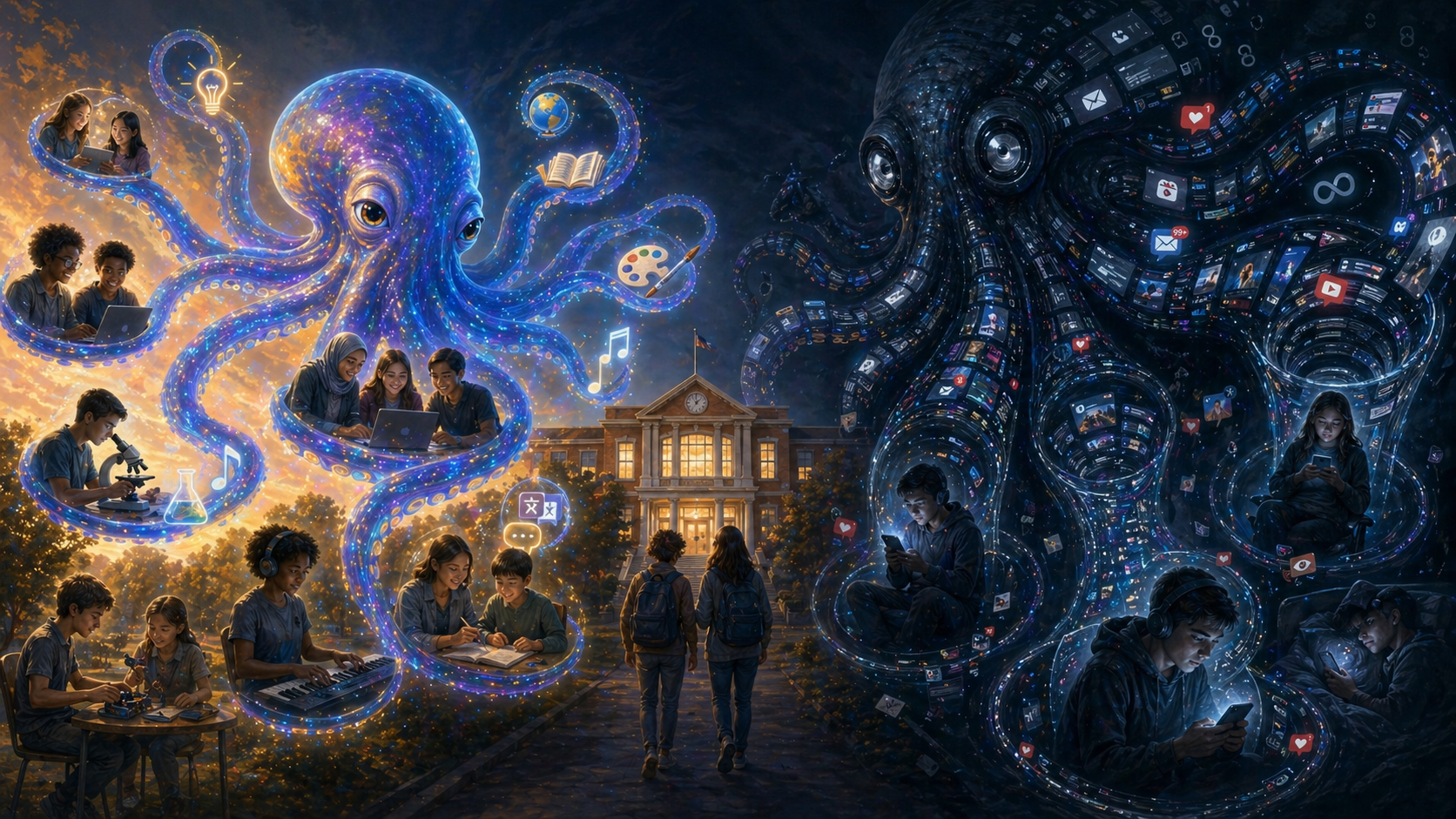
In the image, a school sits between two possible futures.
On one side, a glowing octopus hovers in warm light. Its tentacles are not grabbing or trapping anyone. They are holding spaces open. One tentacle supports students learning music. Another helps with science. Another offers language, creativity, research, connection, and curiosity. Technology here is not the center of life. It is a tool in service of human development.
On the other side is a darker creature: the vampire squid version of technology. Its tentacles are made of apps, notifications, feeds, algorithmic hooks, likes, endless videos, and private little tunnels of attention. Students are not learning together inside its reach. They are isolated inside it. Their faces are lit, but the light does not seem nourishing. It is the glow of capture.
That contrast feels increasingly important as schools debate cell phone and technology policies. I understand the concern. It is hard to argue that constant phone access has been harmless. Many students are navigating anxiety, distraction, sleep disruption, social comparison, bullying, shortened attention spans, and algorithmic entertainment machines designed by adults with budgets far larger than any school district. The concern is real.
But I worry about collapsing all technology into one category.
A phone in a student’s pocket during class is not the same thing as a guided research tool. Endless scrolling is not the same thing as learning to evaluate sources. Algorithmic entertainment is not the same thing as using digital tools to compose music, model climate systems, learn coding, create art, study languages, or collaborate across distance.
One tentacle might open a simulation of the very landscape students walk every day—permafrost thaw in the Alaskan tundra, river levels rising, salmon runs shifting—using tools like En-ROADS, GLOBE Observer, or Salmon Sim. Students adjust variables, watch consequences unfold in real time, then step outside after class and see the same river with new eyes.
Another might pair those models with cold-water survival training—practicing the physiological effects of immersion, proper use of life jackets and immersion suits, and self-rescue techniques—so a student who falls overboard while fishing knows exactly what to do before the cold takes hold. Technology here is not a screen that replaces the world; it is a lens that sharpens it and a rehearsal that can save a life.
A third tentacle might link a classroom in Anchorage to students in a rural village or across an ocean for a shared project—recording oral histories with Terrastories, mapping local food systems in ArcGIS StoryMaps, or co-writing a digital story in two languages through AKRISE or Empatico exchanges. The tool disappears; the conversation and the competence remain. Curiosity, dignity, and connection stay at the center.
On the other side, the vampire squid’s reach is quieter but no less precise. It is the after-school scroll that begins as “just checking one thing” and ends two hours later with a teenager’s face lit by a feed engineered to keep them there—variable rewards, micro-doses of outrage or envy, algorithms that learn their insecurities faster than any teacher ever could. It is the personalized maze that quietly decides a fifteen-year-old will see only the angriest voices on a local issue while another sees only the hopeful ones, both believing they have seen “the truth.” The light on their faces is the same blue glow, but it does not nourish; it extracts.
The question may not be whether technology belongs in schools.
The better question may be: which version of technology are we teaching students to recognize, resist, and use well?
Because if schools simply remove the benevolent forms of technology, students may still meet the vampire squid after school. They may meet it alone, tired, under-supervised, and without much guidance. Their first real education in technology may come from the platforms most skilled at exploiting their attention.
That seems dangerous too.
We do not protect young people from the ocean by pretending water does not exist. We teach them how to swim, how to read currents, how to recognize undertow, how to use a boat, how to know when conditions are unsafe. Technology may require something similar. Not blind adoption. Not total avoidance. A kind of digital seamanship.
This is especially important because students are graduating into a world where technology will shape nearly every future pathway: healthcare, trades, logistics, science, finance, agriculture, education, public service, art, communications, and small business. Even jobs that seem “hands-on” now often require digital fluency. The future does not ask whether someone used a phone in high school. It asks whether they can learn, adapt, verify, communicate, and think clearly inside a technological environment.
That is where schools could matter most.
Schools are one of the few places where young people can encounter technology outside the logic of pure entertainment and profit. A classroom can slow the machine down. It can ask: Who made this? Who benefits? What is being measured? What is being hidden? What does this tool help us see? What does it make us stop noticing?
The image also raises another question: what happens when different people are pulled into different information funnels?
Online, two students might search the same topic and gradually be shown different worlds. One sees science communication. Another sees outrage. One sees civic engagement. Another sees conspiracy. One sees complex human beings. Another sees enemies. Over time, the feed becomes not just a mirror, but a maze.
Sometimes platforms ask, “Are you interested in this post?” That question sounds harmless, almost helpful. But there is something unsettling about a world where every pause, click, scroll, or lack of engagement may quietly decide what reality we are allowed to glimpse next. Even when I scroll past something, I may still want a taste of the wider world. I may want to know what people are saying outside my preferred little aquarium.
That matters for democracy. It matters for empathy. It matters for critical thinking.
Critical thinking is not only the ability to say, “That source is false.” It is the ability to understand why something feels persuasive. It is the ability to notice emotional manipulation before being carried away by it. It is knowing that not every comment deserves equal weight, not every viral post is evidence, and not every feeling of certainty means you have found the truth.
Those skills do not appear automatically at age eighteen. They have to be practiced.
Maybe schools should limit cell phones during the day. Maybe students do need protected time away from the attention economy. Maybe classrooms need more quiet, more presence, more face-to-face conversation, more hands-on learning, more boredom, more depth.
But alongside that, schools may also need stronger technology education, not weaker. Students need to learn how to use tools intentionally rather than compulsively. They need to understand algorithms, privacy, persuasion, misinformation, artificial intelligence, digital creativity, and the economics of attention. They need spaces where technology is not forbidden and not worshiped, but examined.
The guardian octopus is not naive. It does not say all technology is good. It says technology can extend human capacity when it is designed around learning, dignity, creativity, access, and connection.
The vampire squid is not fantasy either. It is what happens when technology is designed mainly to extract attention, data, money, and time.
The challenge for schools is not simply to choose between screens and no screens. The challenge is to help students tell the difference.
A good policy would protect students from the vampire squid without banishing the guardian octopus.
It would create phone-free zones where attention can recover. It would preserve human conversation. It would support teachers instead of dumping another impossible responsibility onto them. It would teach media literacy, digital citizenship, AI literacy, privacy, source evaluation, and emotional self-defense online. It would give students practice using technology to make things, not just consume things.
Because the future will not be less technological. The real question is whether we will send our children into it already fluent in the difference between tool and trap—ready to create, connect, and navigate with clear eyes—or whether we will leave them to be pulled under by the first current that feels like belonging.
This image is not a call to let technology take over education. It is a plea to shape how it enters the classroom.
One version narrows the world into a solitary feed. The other opens it into a shared classroom.
And right now, between those two creatures, our students are already walking into their future. The choice we make today will determine whether they walk as captives—or as captains.