The Higher Clouds
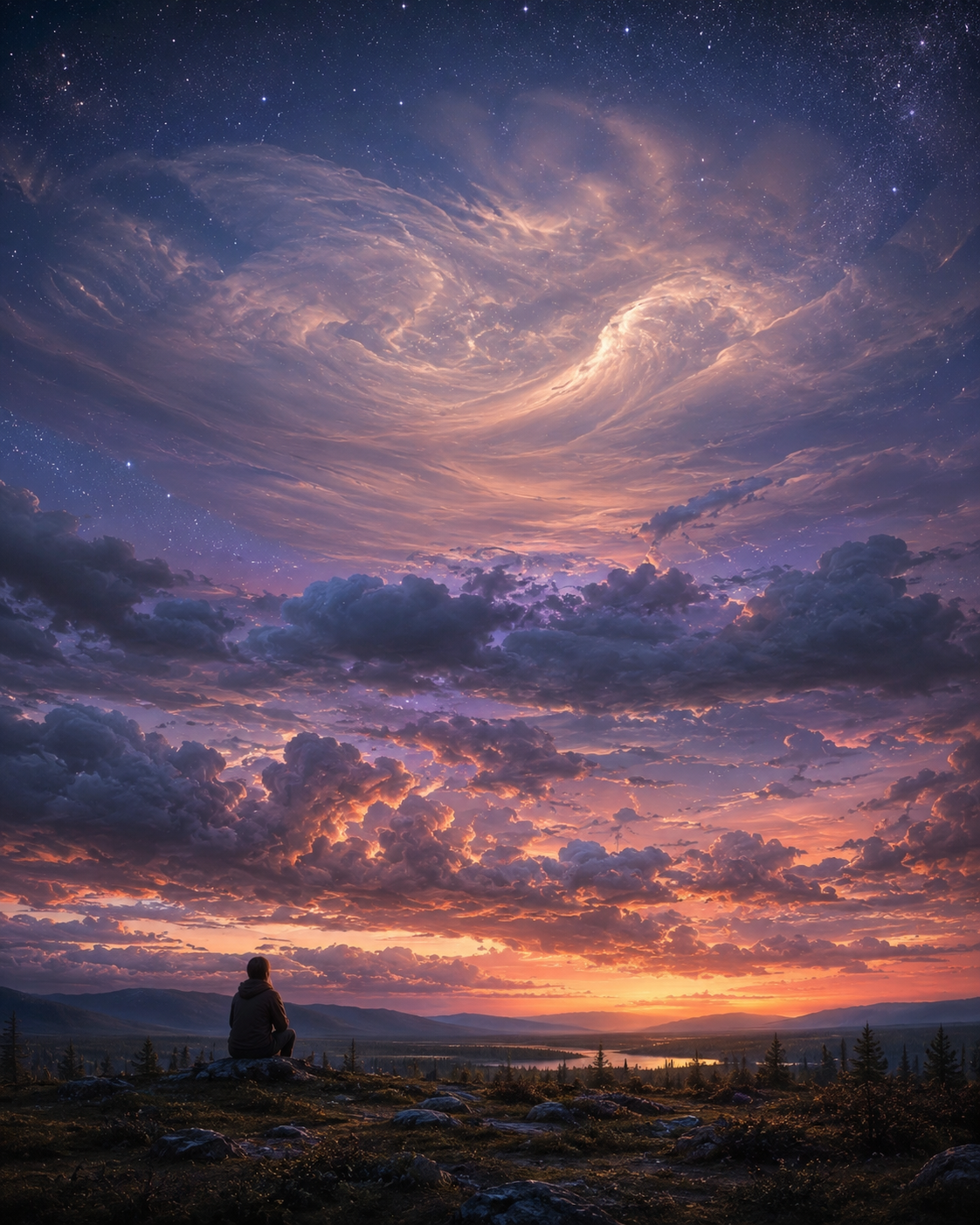
Sometimes I think the only way to feel connected is to be alone.
Not always. But often enough that I’ve started to recognize the pattern.
There are moments when being by myself — in a hot tub under the sky, on a hillside, in a quiet room, walking between errands, even pausing beside an ordinary window — allows something to come back online. The mind settles. The smaller chatter loosens its grip. And then the higher clouds appear.
The lower clouds belong to immediate life. They move faster. They carry the close-range weather of being a person: first days of college, uneasy transitions into adulthood, workdays that begin in confusion and end in competence, losses, attractions, misunderstandings, errands, responsibilities, dogs to let out, zucchini under duress. These are the clouds nearest to the ground. They matter because they are lived.
But above them are the slower clouds.
These feel like the gathered pattern of many lives. Not one person’s story, but the shape that emerges when countless stories rise and overlap: care given and received, roles inherited and revised, hope, disappointment, duty, endurance, longing, repair. The fingerprint of the human condition.
Sometimes I imagine that all our individual experiences trickle upward into those higher clouds. The private firsts, the quiet griefs, the ordinary acts of responsibility, the ways we love imperfectly, the ways we adapt. Over time, even the higher clouds change shape. What once looked fixed begins to soften. What once seemed central drifts to the edges. A generation passes, then another, and the arrangement shifts again.
I’ve been thinking lately about forms of care and the roles that once seemed more established than they do now. Not from a place of judgment, but from observation. There were ways of organizing life — within marriage, family, obligation, and interdependence — that once appeared more settled, even as they were already changing. In some lives, women absorbed the labor of care almost invisibly. In others, husbands became caretakers in ways that complicated simpler narratives. And now, in many cases, care is increasingly outsourced to institutions, systems, and businesses that take on what families once held themselves.
The clouds look a little different now.
That doesn’t necessarily mean they are worse. It does mean they have changed, and change always signifies something. Value shifts. Stability appears, disappears, reappears in altered form. What one generation took for granted, the next may renegotiate entirely. From ground level, these changes can feel scattered and personal. From a little distance, they begin to resemble weather.
This is one reason I return to solitude. Not to escape other lives, but to feel more deeply connected to them. Alone, I can sometimes sense the continuity more clearly — the ancestors who lived through their own versions of transition and uncertainty, who inhabited different structures and believed different things, but still moved through the same basic human weather. Their lives were not my life. Their skies were not my skies. And still, something resonates.
Sometimes the clouds are overhead. Sometimes they are recreated in the mind’s own eye. Sometimes sanctuary is not a place you find, but a place you return to within yourself — an inner clearing with access to memory, pattern, and perspective.
That sanctuary is never perfect. It knows about the light, but it also wonders about the dark. Shame, envy, cruelty, indifference — these too belong to the human atmosphere. To zoom out is not to become naïve. It is simply to recognize that more than one truth is often present at once.
And so I look upward, or inward, and let the mind travel.
The lower clouds move quickly. The higher clouds move slowly. Both are real. Both belong.
Sometimes you need to be alone to feel how profoundly un-alone you are.