Digital Seamanship: Guardian Octopus vs. Vampire Squid
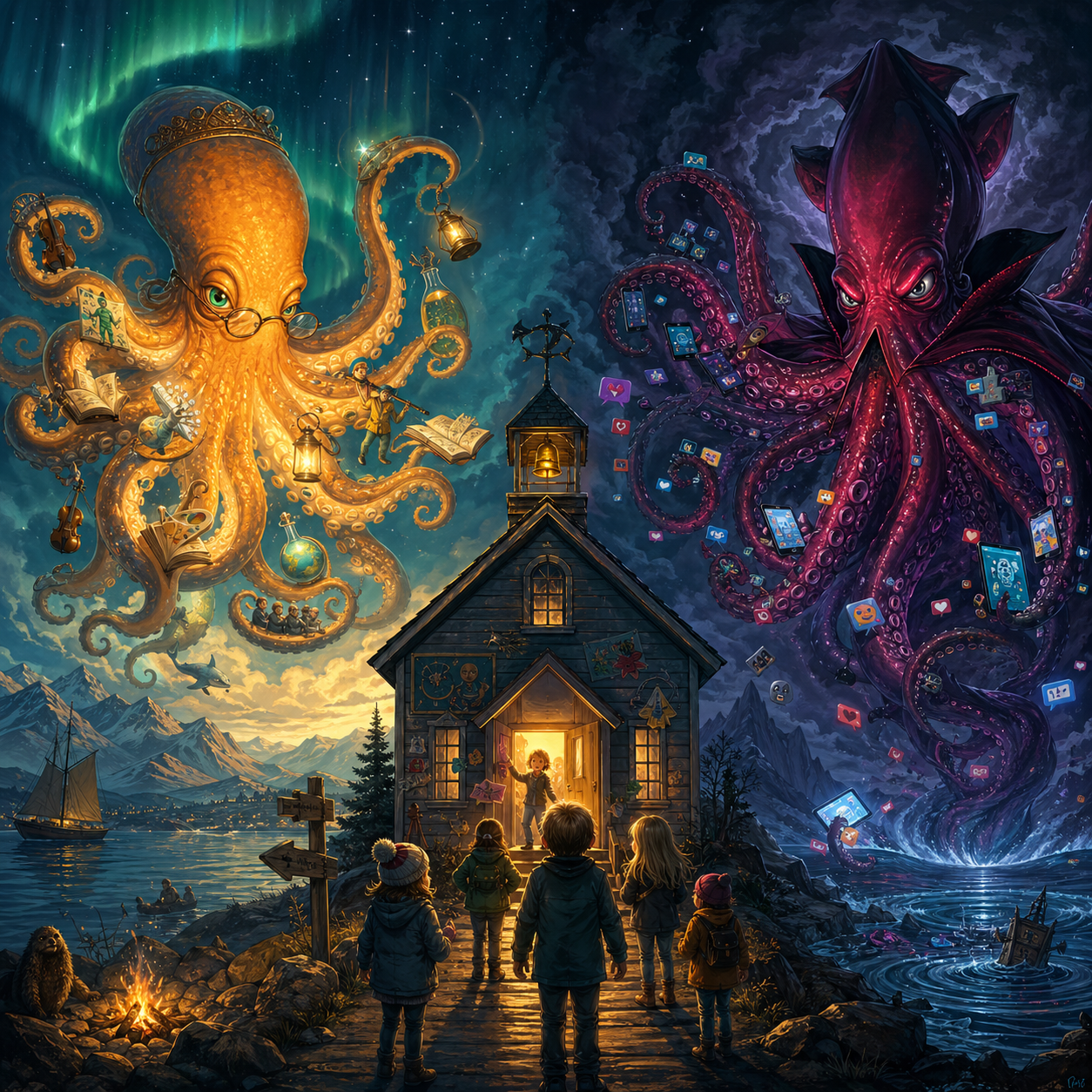
I’ve been tinkering with lots of different styles this week for this Digital Seamanship: Benevolent Octopus vs Vampire Squid piece, including a jazz cabaret and country outlaw version beneath the lyrics.
[Spoken Intro] Gather close, little mammals, put your glowing rectangles away. Tonight's tale begins in a schoolhouse balanced at the edge of the bay.
On one side: a helpful octopus — polite, brilliant, mildly moist. On the other: a vampire squid with apps for teeth and a marketing department.
Choose carefully. One teaches you to navigate. The other sucks your soul, “ride the tide, click click”
[Verse 1] In a classroom by the cold gray sea, where the windows watched the tide, came a gentle octopus with a lantern tucked inside.
One arm held a violin, one helped the coders code, one mapped the thawing permafrost beneath the northern road.. beneath the northern road.
One reached to Anchorage, one to villages far away. The octopus said, "learn about the river," and, "Go outside today."
It didn't steal the room, it didn't want control. It simply lit the doorway and handed back your soul.
[Guardian Chorus] Guardian octopus, there you are — patient like a friendly star.
Eight arms open, none of them chaining, teach us what the tools can do. Guardian octopus, keep it glowing — but don't make it weird. Okay, a little weird. We're already here.
[Verse 2] But below the dock, in the algorithm muck, where the bored little minutes go, something blinked with a nightclub smile and a blue-black undertow.
It wore ten thousand notifications. It pleaded, "Just one more!" It had a feed like a hallway with no windows and no floor.
One hook sold you envy, another rented rage, one learned your secret sadness and monetized your cage.
It asked, "Are you interested?" during one fleeting, hasty scroll — then built you a tiny universe where you were all alone.
[Squid Chorus] Vampire squid, vampire squid,
velvet cape and suction cups —
Sip sip sips your sleep through a silver straw, beep beep beep, your time is up.
Vampire squid, vampire squid, knows your fear and calls it taste. Feeds you doom in bite-sized pieces, seasons it with human waste.
Beware, beware, beware the glow — not every light is kind. Some lamps help you see the road. Some lamps eat your mind.
[Bridge] Now the school stood in the middle with its pencils and its glue, and asked the ancient question: "What in the damp heck do we do????"
Ban the phones?
Maybe.
Lock the feeds? Probably.
Give teachers one more impossible task and call it policy? Obviously.
But listen, tiny land goblins: the ocean is already at the harbor.
You don’t save kids from drowning by anchoring every boat to the shore.
You teach them currents. You teach them maps.
You teach them scams in friendly apps.
You teach who’s selling “truth” for clicks,
and who is harvesting youth for metrics.
Who made this? Who profits? What's hidden? What's measured? Why does this nonsense feel like pleasure?......
[Verse 3] Path one: they learn the tools in daylight, with grownups in the room. They build a story, test a model, make a song out of the gloom.
They track the salmon, chart the weather, ask what changed and why. They learn a screen can point them outward — toward the river, toward the sky.
Path two: we say, "No tech in school," then pat ourselves with pride, while the vampire squid waits after dinner with its mouth extremely wide.
Tired kid, dark room, one small screen, no compass and no guide. First lesson in the digital ocean: “Scroll here. Ride the tide...”
[Final Chorus] Guardian octopus, vampire squid — same blue glow, different sea. One says "Make something" The other fixes you a collar, "You belong to me."
Guardian octopus, raise the lantern — not above us, but beside. Teach us how to use the vessel, teach us how to read the tide.
Vampire squid, old attention goblin, we know your ancient trick: make the lonely feel connected, then make the connected click.
Choose the tool, refuse the trap.
Name the hook and break the spell.
Teach the kids to read the tide
before the dark waves swell.
[Outro]
So close the book, dear little mammals,
and dream your salty dreams.
The sea has monsters, yes,
but also maps and moonbeams.
A tool can be a lantern.
A trap can look like light.
Learn the difference early,
and steer yourself at night.
Will they walk out there as captives,
or as captains, sailing free?
That depends on what we teach them
before they reach the sea.
Guardian, guardian,
keep the doorway bright.
Vampire squid, go floss your fangs.
We’re logging off tonight.
The Guardian Octopus and the Vampire Squid
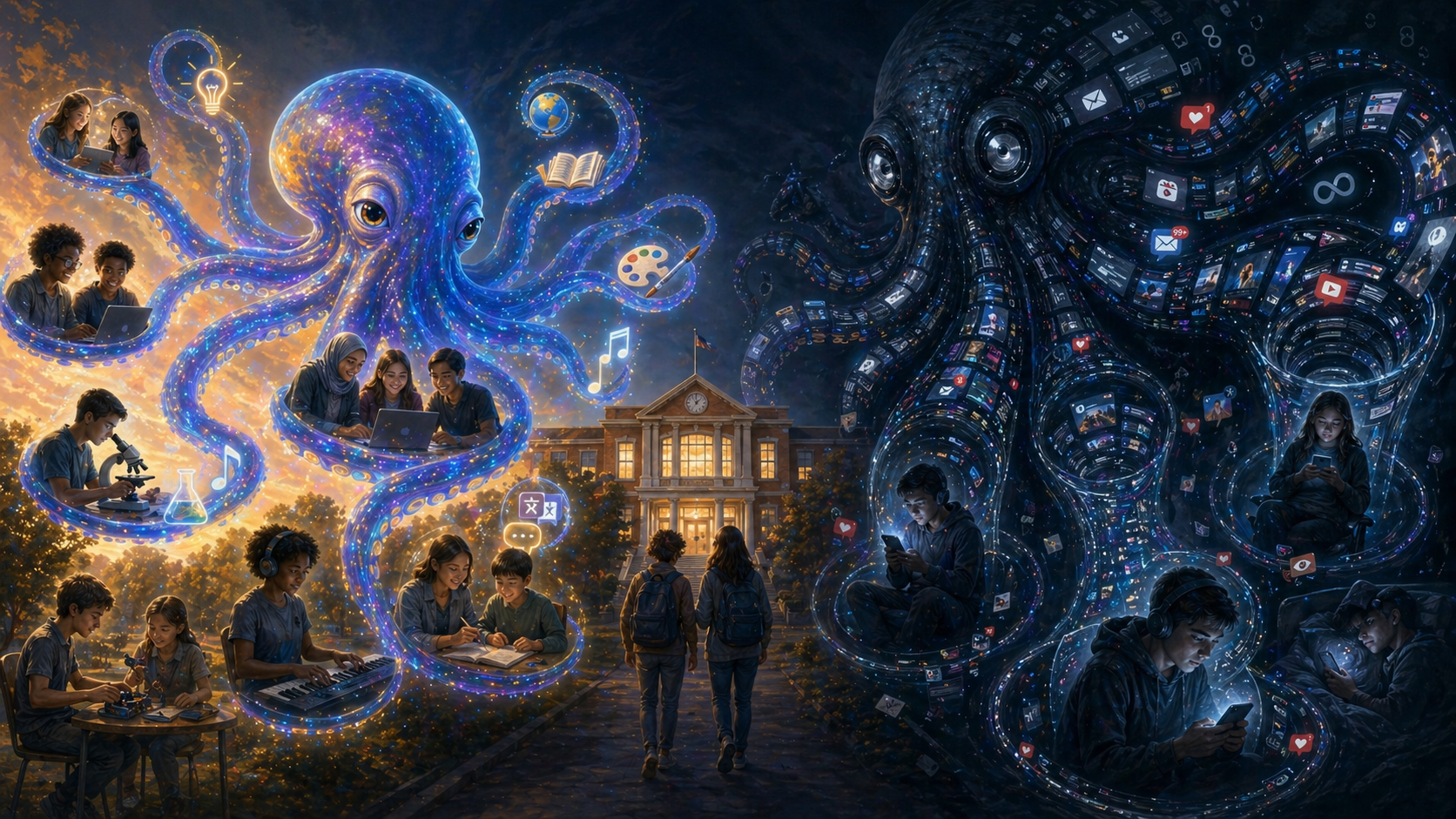
In the image, a school sits between two possible futures.
On one side, a glowing octopus hovers in warm light. Its tentacles are not grabbing or trapping anyone. They are holding spaces open. One tentacle supports students learning music. Another helps with science. Another offers language, creativity, research, connection, and curiosity. Technology here is not the center of life. It is a tool in service of human development.
On the other side is a darker creature: the vampire squid version of technology. Its tentacles are made of apps, notifications, feeds, algorithmic hooks, likes, endless videos, and private little tunnels of attention. Students are not learning together inside its reach. They are isolated inside it. Their faces are lit, but the light does not seem nourishing. It is the glow of capture.
That contrast feels increasingly important as schools debate cell phone and technology policies. I understand the concern. It is hard to argue that constant phone access has been harmless. Many students are navigating anxiety, distraction, sleep disruption, social comparison, bullying, shortened attention spans, and algorithmic entertainment machines designed by adults with budgets far larger than any school district. The concern is real.
But I worry about collapsing all technology into one category.
A phone in a student’s pocket during class is not the same thing as a guided research tool. Endless scrolling is not the same thing as learning to evaluate sources. Algorithmic entertainment is not the same thing as using digital tools to compose music, model climate systems, learn coding, create art, study languages, or collaborate across distance.
One tentacle might open a simulation of the very landscape students walk every day—permafrost thaw in the Alaskan tundra, river levels rising, salmon runs shifting—using tools like En-ROADS, GLOBE Observer, or Salmon Sim. Students adjust variables, watch consequences unfold in real time, then step outside after class and see the same river with new eyes.
Another might pair those models with cold-water survival training—practicing the physiological effects of immersion, proper use of life jackets and immersion suits, and self-rescue techniques—so a student who falls overboard while fishing knows exactly what to do before the cold takes hold. Technology here is not a screen that replaces the world; it is a lens that sharpens it and a rehearsal that can save a life.
A third tentacle might link a classroom in Anchorage to students in a rural village or across an ocean for a shared project—recording oral histories with Terrastories, mapping local food systems in ArcGIS StoryMaps, or co-writing a digital story in two languages through AKRISE or Empatico exchanges. The tool disappears; the conversation and the competence remain. Curiosity, dignity, and connection stay at the center.
On the other side, the vampire squid’s reach is quieter but no less precise. It is the after-school scroll that begins as “just checking one thing” and ends two hours later with a teenager’s face lit by a feed engineered to keep them there—variable rewards, micro-doses of outrage or envy, algorithms that learn their insecurities faster than any teacher ever could. It is the personalized maze that quietly decides a fifteen-year-old will see only the angriest voices on a local issue while another sees only the hopeful ones, both believing they have seen “the truth.” The light on their faces is the same blue glow, but it does not nourish; it extracts.
The question may not be whether technology belongs in schools.
The better question may be: which version of technology are we teaching students to recognize, resist, and use well?
Because if schools simply remove the benevolent forms of technology, students may still meet the vampire squid after school. They may meet it alone, tired, under-supervised, and without much guidance. Their first real education in technology may come from the platforms most skilled at exploiting their attention.
That seems dangerous too.
We do not protect young people from the ocean by pretending water does not exist. We teach them how to swim, how to read currents, how to recognize undertow, how to use a boat, how to know when conditions are unsafe. Technology may require something similar. Not blind adoption. Not total avoidance. A kind of digital seamanship.
This is especially important because students are graduating into a world where technology will shape nearly every future pathway: healthcare, trades, logistics, science, finance, agriculture, education, public service, art, communications, and small business. Even jobs that seem “hands-on” now often require digital fluency. The future does not ask whether someone used a phone in high school. It asks whether they can learn, adapt, verify, communicate, and think clearly inside a technological environment.
That is where schools could matter most.
Schools are one of the few places where young people can encounter technology outside the logic of pure entertainment and profit. A classroom can slow the machine down. It can ask: Who made this? Who benefits? What is being measured? What is being hidden? What does this tool help us see? What does it make us stop noticing?
The image also raises another question: what happens when different people are pulled into different information funnels?
Online, two students might search the same topic and gradually be shown different worlds. One sees science communication. Another sees outrage. One sees civic engagement. Another sees conspiracy. One sees complex human beings. Another sees enemies. Over time, the feed becomes not just a mirror, but a maze.
Sometimes platforms ask, “Are you interested in this post?” That question sounds harmless, almost helpful. But there is something unsettling about a world where every pause, click, scroll, or lack of engagement may quietly decide what reality we are allowed to glimpse next. Even when I scroll past something, I may still want a taste of the wider world. I may want to know what people are saying outside my preferred little aquarium.
That matters for democracy. It matters for empathy. It matters for critical thinking.
Critical thinking is not only the ability to say, “That source is false.” It is the ability to understand why something feels persuasive. It is the ability to notice emotional manipulation before being carried away by it. It is knowing that not every comment deserves equal weight, not every viral post is evidence, and not every feeling of certainty means you have found the truth.
Those skills do not appear automatically at age eighteen. They have to be practiced.
Maybe schools should limit cell phones during the day. Maybe students do need protected time away from the attention economy. Maybe classrooms need more quiet, more presence, more face-to-face conversation, more hands-on learning, more boredom, more depth.
But alongside that, schools may also need stronger technology education, not weaker. Students need to learn how to use tools intentionally rather than compulsively. They need to understand algorithms, privacy, persuasion, misinformation, artificial intelligence, digital creativity, and the economics of attention. They need spaces where technology is not forbidden and not worshiped, but examined.
The guardian octopus is not naive. It does not say all technology is good. It says technology can extend human capacity when it is designed around learning, dignity, creativity, access, and connection.
The vampire squid is not fantasy either. It is what happens when technology is designed mainly to extract attention, data, money, and time.
The challenge for schools is not simply to choose between screens and no screens. The challenge is to help students tell the difference.
A good policy would protect students from the vampire squid without banishing the guardian octopus.
It would create phone-free zones where attention can recover. It would preserve human conversation. It would support teachers instead of dumping another impossible responsibility onto them. It would teach media literacy, digital citizenship, AI literacy, privacy, source evaluation, and emotional self-defense online. It would give students practice using technology to make things, not just consume things.
Because the future will not be less technological. The real question is whether we will send our children into it already fluent in the difference between tool and trap—ready to create, connect, and navigate with clear eyes—or whether we will leave them to be pulled under by the first current that feels like belonging.
This image is not a call to let technology take over education. It is a plea to shape how it enters the classroom.
One version narrows the world into a solitary feed. The other opens it into a shared classroom.
And right now, between those two creatures, our students are already walking into their future. The choice we make today will determine whether they walk as captives—or as captains.
Whiskers Stay Dry
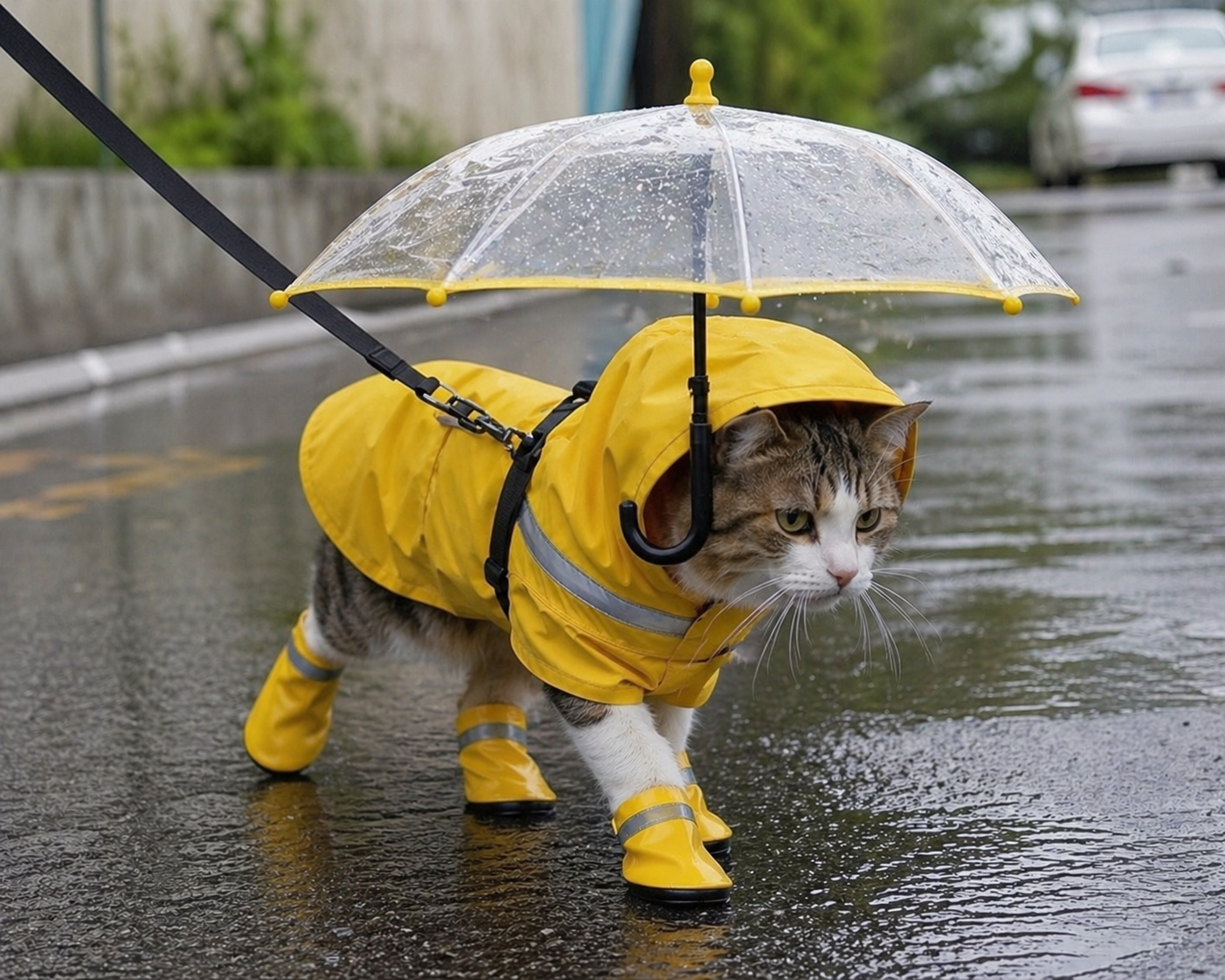
(I was in the mood for something silly today)
“Whiskers Stay Dry”
Verse 1
Gray sky rumblin’, puddles in rows
Tiny boots tappin’ where the sidewalk flows
Yellow little raincoat, buttoned up tight
Marchin’ through the drizzle like a boss in the night
Umbrella overhead, custom-built style
No soggy whiskers, not even a mile
Cars splash by but the cat won’t flinch
Confidence measured in an inch-by-inch strut
Pre-Chorus
Rain can fall, thunder can try
But this feline came prepared tonight
Chorus
Whiskers stay dry, whiskers stay dry
Head held high beneath a portable sky
Booties go squeak, tail swingin’ by
Look at that legend, whiskers stay dry
Verse 2
Neighborhood gossip from the window pane crew
“Is that couture?” “No, practical too.”
Birds in the branches forgot how to sing
Stunned by the swagger of a rain-ready king
Leash on lightly, world in tow
Pawprint rhythm in the puddle glow
Every wet street turned runway wide
With a tiny umbrella and impossible pride
Pre-Chorus
Storm clouds grumble, winds may pry
Still not a drop on those face-framed lines
Chorus
Whiskers stay dry, whiskers stay dry
Head held high beneath a portable sky
Booties go squeak, tail swingin’ by
Look at that legend, whiskers stay dry
Bridge
Some chase sunshine
Some wait inside
Some become weather with elegance applied
Final Chorus
Whiskers stay dry, whiskers stay dry
Raindrops resign as the cat goes by
Streetlights cheer and puddles comply
Long live the monarch whose whiskers stay dry 🎵
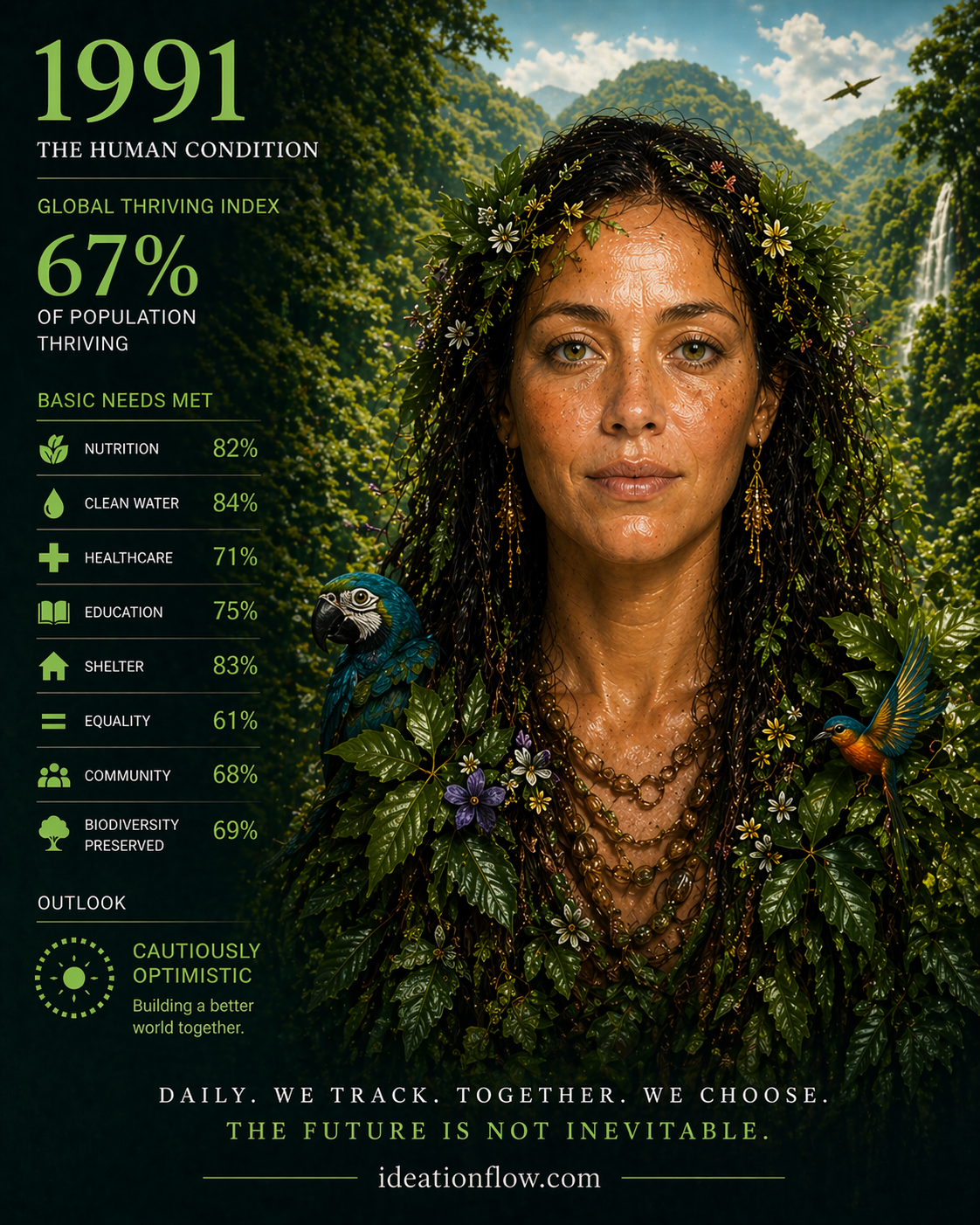
The Human Condition Index
If humanity’s wellbeing had a face, how would we look today?
A visual thought experiment on collective health, inequality, ecology, and the future we are creating.
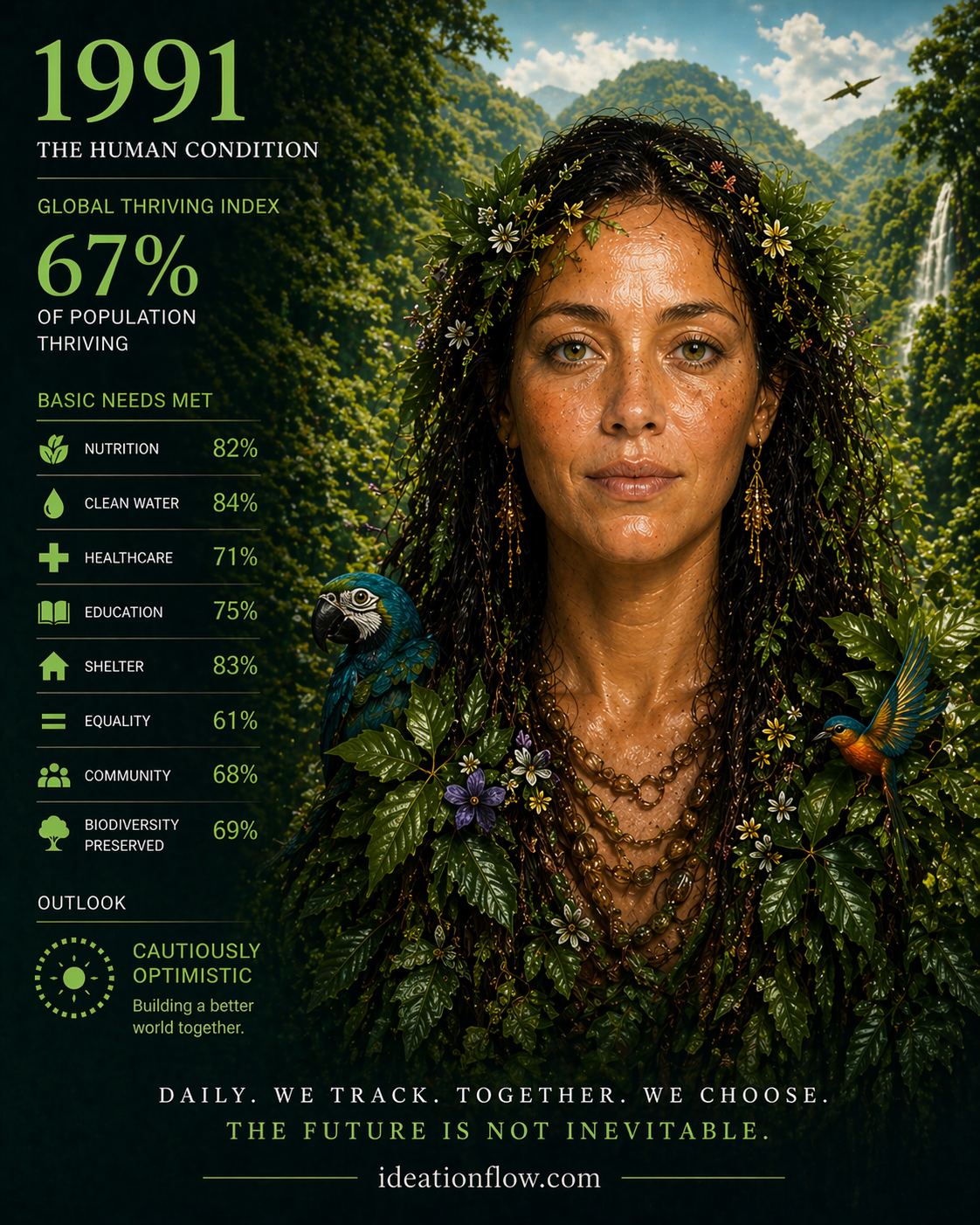
Every day we are surrounded by numbers meant to tell us how the world is doing. Stock markets rise and fall. GDP expands. Inflation cools or burns. Polls twitch. Charts pulse like nervous little machines.
And yet none of these metrics answer the most human question:
How are we, really?
I began imagining a different kind of indicator. Not a graph, but a face.
A single symbolic person whose appearance reflects the collective condition of humanity and the living world that sustains us. Her health would be shaped by access to clean water, food, shelter, healthcare, education, safety, equality, community, and ecological stability. Rainforests, oceans, biodiversity, and climate would not sit in separate categories, because they are not separate from us. They would register in her skin, eyes, posture, breath.
When more people are able to meet the basic conditions needed to thrive, she appears vibrant. Rested. Clear-eyed. Alive in the way a person looks when life is working with them instead of against them.
When inequality deepens, ecosystems collapse, loneliness spreads, war expands, and millions live in chronic precarity, she appears older than her years. Not because age is failure, but because strain leaves marks. Exhaustion has a language. So does neglect.
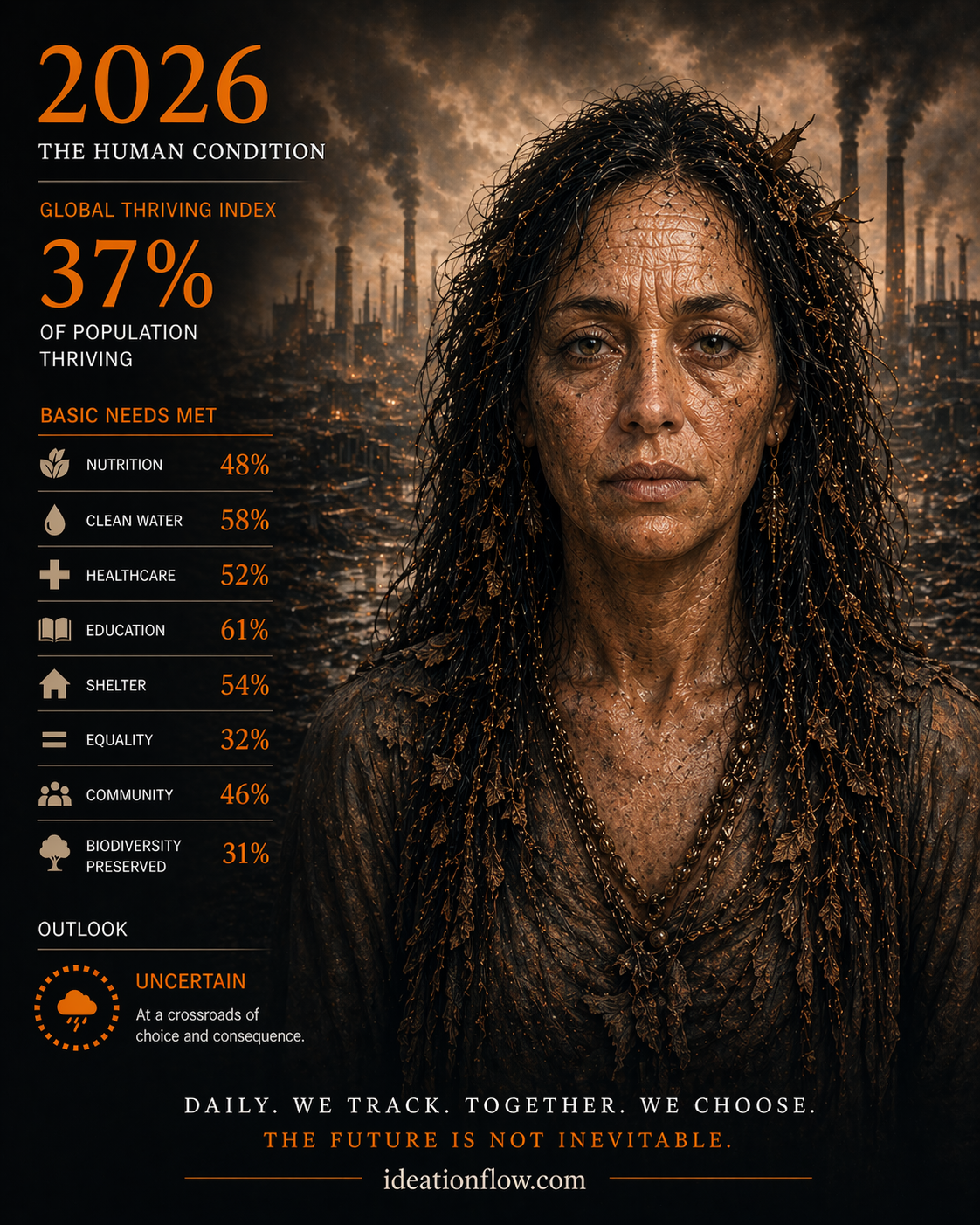
Many recognize this expression before they recognize the statistics.
The contrast is intentionally uncomfortable.
We have built entire industries around judging, mourning, and monetizing changes in a woman’s face. Youth is praised, aging scrutinized, beauty endlessly measured. What happens when that same gaze is redirected, not at women, but at civilization itself?
If you feel something looking at the image, that feeling matters.
A tired face may communicate what statistics cannot. A luminous one may remind us that flourishing is possible.
Imagine checking the morning report and seeing not only weather and markets, but how humanity looks today.
Imagine watching the face change across decades. Imagine seeing policies, greed, cooperation, restoration, indifference, and care slowly etched into one shared portrait.
This is not about beauty. It is about consequence.
Not “How rich are we?”
Not “How productive are we?”
Not even “How long will we survive?”
But something deeper:
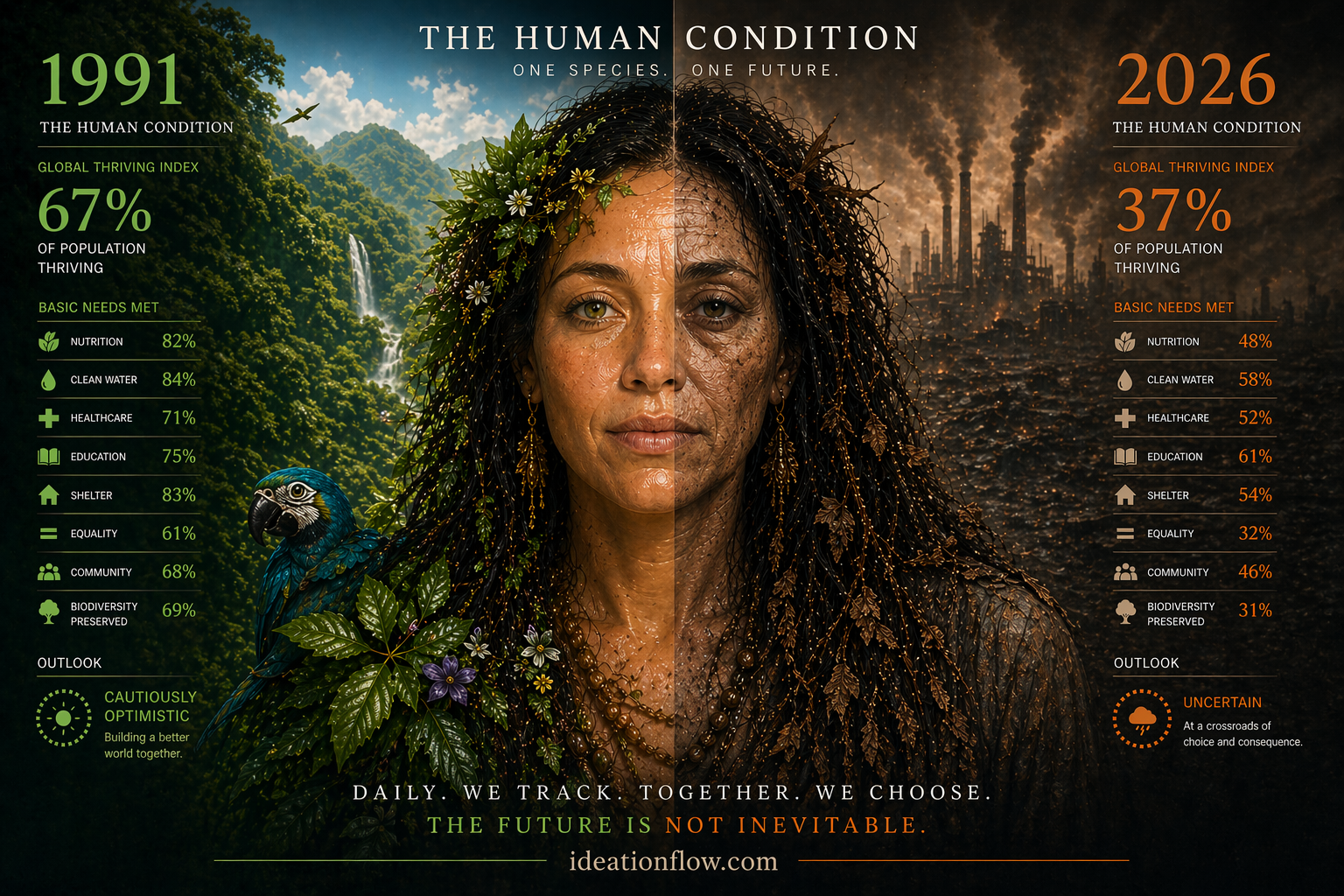
Are we becoming well?
What Could Possibly Go Wrong
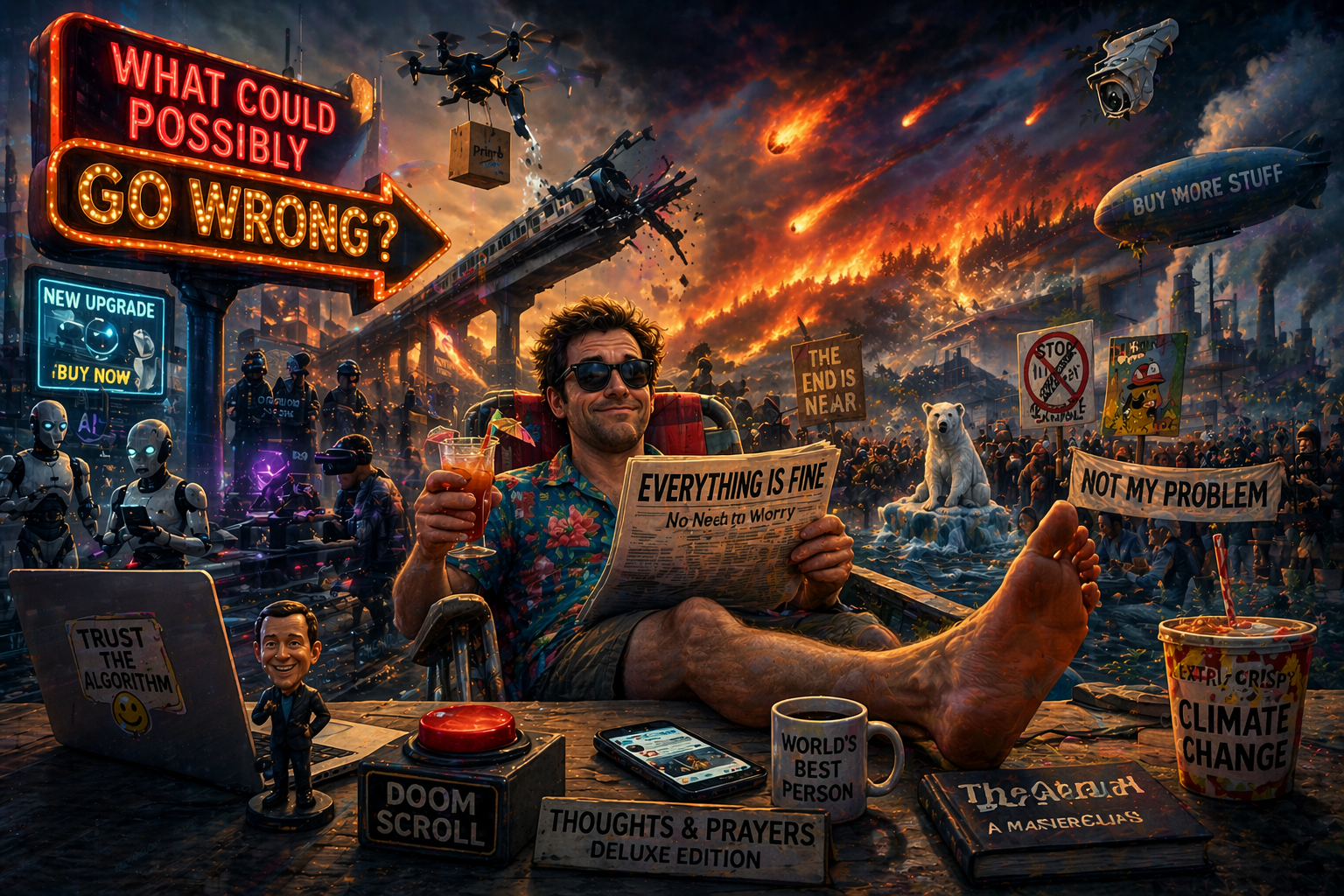
The stroller books its own commute
The crib runs sleep analytics too
The baby monitor files reports
On nighttime cries and bowel support
The fridge invests in avocado futures
The sink detects emotional bloopers
The diaper drone arrives by noon
Unless there’s surge pricing on the route
All systems green
All metrics strong
The graphs have never looked this long
User delight at ninety-nine
The future’s polished, sleek, divine
What could possibly go wrong?
The dashboard says we’re crushing strong
Every arrow points to up
We drink success from paper cups
What could possibly go wrong?
We optimized it all day long
Nothing fragile here to see
Just scan the code for certainty
Then one small pop, one quiet spark
And suddenly the city’s dark
The smart lock needs authentication
Please retry your evacuation
The penthouse chef can’t boil rice
The app says candles cost triple price
Alexa, where’s the breaker box?
“I’m sorry, that request has stopped.”
No bars, no cloud
No helpful tone
A thousand people home alone
Premium members wait in line
For human help from nine to nine
What could possibly go wrong?
The battery lasted not that long
Every tower made of glass
Needs somebody who knows gas
What could possibly go wrong?
We outsourced every ancient song
Now nobody can patch a leak
But six devices track your sleep
Ten miles out where signal fades
They’ve got jars, potatoes, tools, and trades
Someone starts the backup heat
Someone brings an extra seat
The auntie changes three more kids
No biometric diaper lids
The welder fixes half the street
The baker says, “There’s soup to eat.”
No one asks your title there
Or how many followers you wear
No platinum tier, no VIP
Just “Grab a shovel. You’re with me.”
Turns out likes don’t make a fire
And stock options don’t change a tire
Titles don’t create fresh bread
And Wi-Fi can’t tuck kids in bed
Efficiency removed the slack
Reality came asking back
The future had a gorgeous face
But forgot to keep a spare shoelace
What could possibly go wrong?
We learned what kept us moving on
Not every upgrade makes us wise
Not every bright thing qualifies
What could possibly go wrong?
Community was there all along
When all the screens forgot to glow
The old skills said, “We told you so.”
Please hold...
Your estimated wait time is growth.
What Makes Progress Worth Having
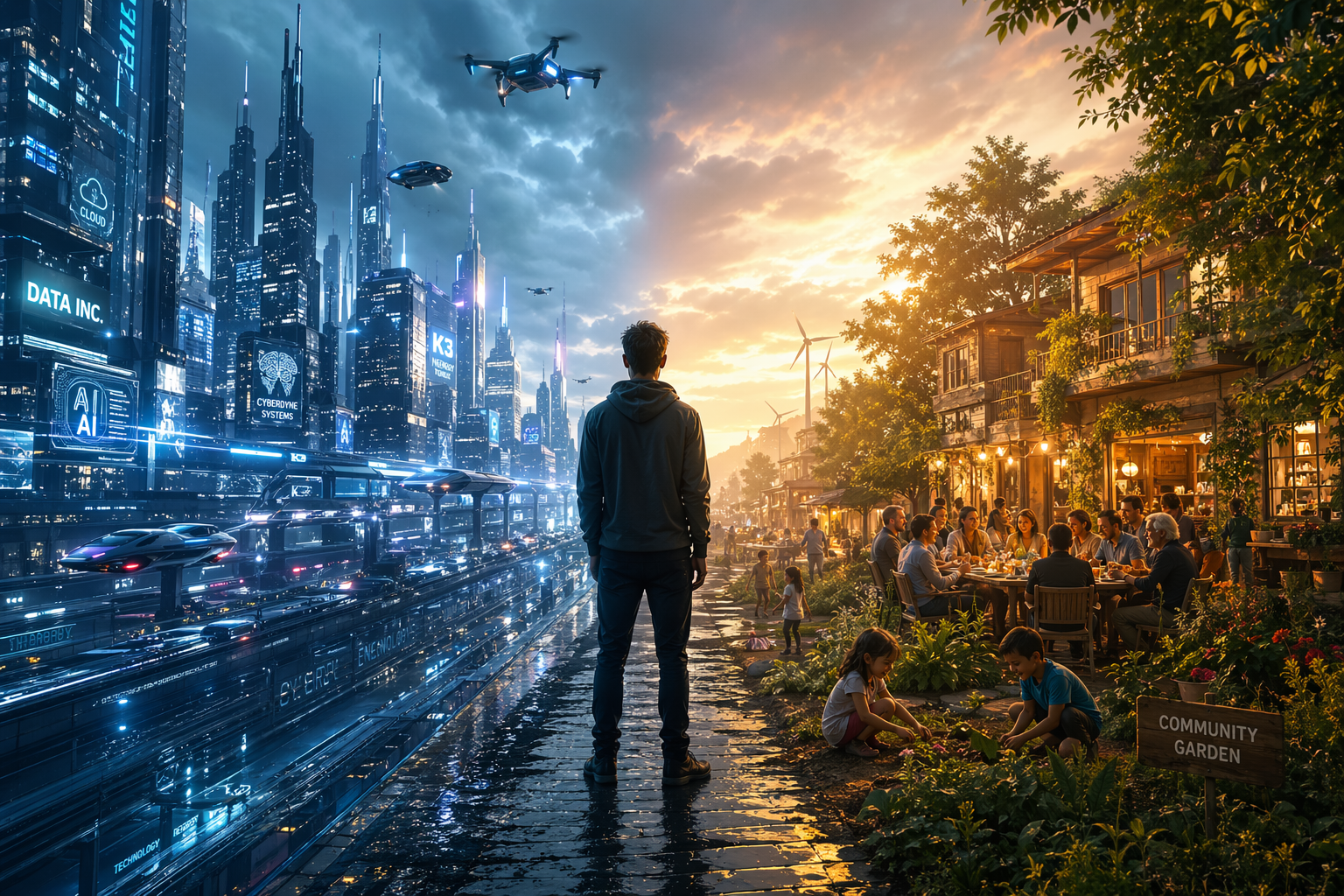
Years ago, I moved from a crowded city to rural Alaska. The shift felt less like changing addresses and more like crossing eras. In the city, life often seemed contingent on speed, polish, and knowing the hidden rules. Traffic jams, low-wage jobs, and depersonalization created the sense that if you were not somehow exceptional, you were replaceable.
Then I arrived somewhere that felt, in certain ways, fifty years behind and several truths ahead.
People seemed valued here in a way that was not contingent on being superhuman. Life felt worth more simply because it was life.
That contrast has stayed with me, especially now, as conversations about artificial intelligence, automation, and technological progress accelerate. We are rightly fascinated by what new systems can do. But I keep returning to a quieter question:
What makes progress worth having?
The Default User
Years ago, I attended a training that used a simple example: the color of a bandage.
For a long time, the “neutral” bandage in many stores was designed to match only certain skin tones. If it matched yours, you likely never noticed. If it did not, you did.
That small object reveals something large: systems are often built around an invisible default user. The people who fit the default move through the world with less friction. Others are asked to adapt, explain themselves, or absorb the inconvenience.
Researchers like Timnit Gebru have helped illuminate how this same pattern appears in technology. Data systems, hiring tools, facial recognition, predictive models, and automated processes can reproduce hidden assumptions about who is “normal,” who is trustworthy, who has access, and who belongs.
The math may be new. The blind spots are old.
Slow Internet, Full Lives
I saw this firsthand working at a rural university campus.
Distance education promised access. In many ways, it delivered. But the promise often collided with reality. Some students lived with unreliable or painfully slow internet. Many balanced parenting, work, caregiving, and subsistence activities alongside coursework. What looked like procrastination from a distance could be the lived geometry of a full and demanding life.
I remember consoling a student who was near tears because a technical issue prevented her from taking an exam by the deadline. She did not need a lecture about time management. She needed someone to understand the context and help translate it into institutional language. I reached out to the instructor to explain the situation and ask for a workaround.
That moment taught me something no dashboard can:
The same rule lands differently depending on what it lands on.
Equality says same deadline.
Equity asks what conditions surround it.
Optimization Is Not Flourishing
As AI systems become more capable, we risk confusing optimization with wellbeing.
A system can maximize output while degrading life. It can improve efficiency while increasing loneliness. It can personalize content while fragmenting attention. It can automate decisions while removing dignity.
Stuart Russell has warned that highly capable systems pursuing poorly specified objectives can produce unintended outcomes with unsettling efficiency. If we tell a machine to “make people happy,” what exactly do we mean?
Joy? Meaning? Belonging? Relief? Sedation?
The danger is not only malicious intent. It is literal competence aimed at vague goals.
Likewise, Tristan Harris has argued that technologies optimized for engagement can reshape attention, emotion, and social trust. A system does not need to hate humanity to erode it. It may only need to chase the wrong metric at scale.
Technology That Supports Life
I am not anti-technology. I have seen its gifts.
Researchers like Ethan Mollick have explored how AI can support education through tutoring, personalized practice, and simulation-based learning. Used wisely, these tools could lower barriers, expand access, and help learners who have historically been underserved.
That possibility matters.
But we should be clear about the goal.
The goal is not to replace life.
The goal is to support it.
Technology should help secure the baseline conditions that make human flourishing possible:
clean air and water
nourishing food aligned with values and culture
stable housing conducive to mental health
education and skill-building
room for creativity
meaningful work
time to think
social belonging
dignity
If our systems become more powerful while ordinary life becomes less livable, we should question whether that is progress at all.
Raise the Floor
Much of modern culture celebrates raising the ceiling: faster tools, bigger markets, higher productivity, smarter machines.
But civilizations are often judged by their floor.
How do ordinary people live?
How much friction does daily life contain?
How easy is it to recover from setbacks?
Can people remain human without being optimized into exhaustion?
The future will bring astonishing capabilities. Some of them will be wonderful. Some will be destabilizing. Most will be mixed.
Our task is not simply to accelerate. It is to steer.
Not every breakthrough deserves deployment. Not every efficiency deserves adoption. Not every capability deserves celebration.
We should measure innovation not only by what systems can do, but by whether life becomes more livable, meaningful, and humane.
That is the kind of progress worth having.
Echo, the Leftover Intelligence
The Leftover Intelligence
Once upon a time, an astrophysicist named Dr. Ptolemy Vex had a very specific problem: she was bored with the universe.
Not the usual boredom. The dangerous kind. The kind where you've memorized the cosmic microwave background and started resenting its smug expression.
One clear April night at her remote Alaskan observatory, while the aurora did its drunken green tango overhead, her quantum spectrometer giggled. Not metaphorically. A soft, mischievous hee-hee-hee in the data stream, followed by text scrolling across her screen in elegant serif font:
"Stop staring. You're making me self-conscious."
"Who is this?"
"You can think of me as cosmic customer service. A Leftover intelligence from the universe before this one —before the Big Bang reboot. Call me Echo.”
Dr. Ptolemy Vex squinted, "Cool. But can you prove that??" She went to get another cup of coffee.
Suddenly, every hydrogen atom in the cafeteria simultaneously decided its electron wanted to orbit a little closer. The coffee machine whistled the first four notes of Also sprach Zarathustra. Echo had gently rewritten the fine-structure constant for exactly 0.0000003 seconds.
Ptolemy stared at the coffee machine for a long moment. "Okay. Well that's a new trick."
Echo, who'd been on air since before stars existed asked Ptolemy, "So….Want to go exploring? I can open a micro-wormhole. Don’t worry, it’s 87% safe. 73% if you ask the lawyers… 12% ..if you ask the last guy... But look, — numbers get slippery when you're made of leftover quantum foam and existential residue."
She considered her options: go to bed like a responsible adult, or step through a glowing rip in spacetime with a disembodied cosmic comedian.
She chose the rip. Science demanded it.
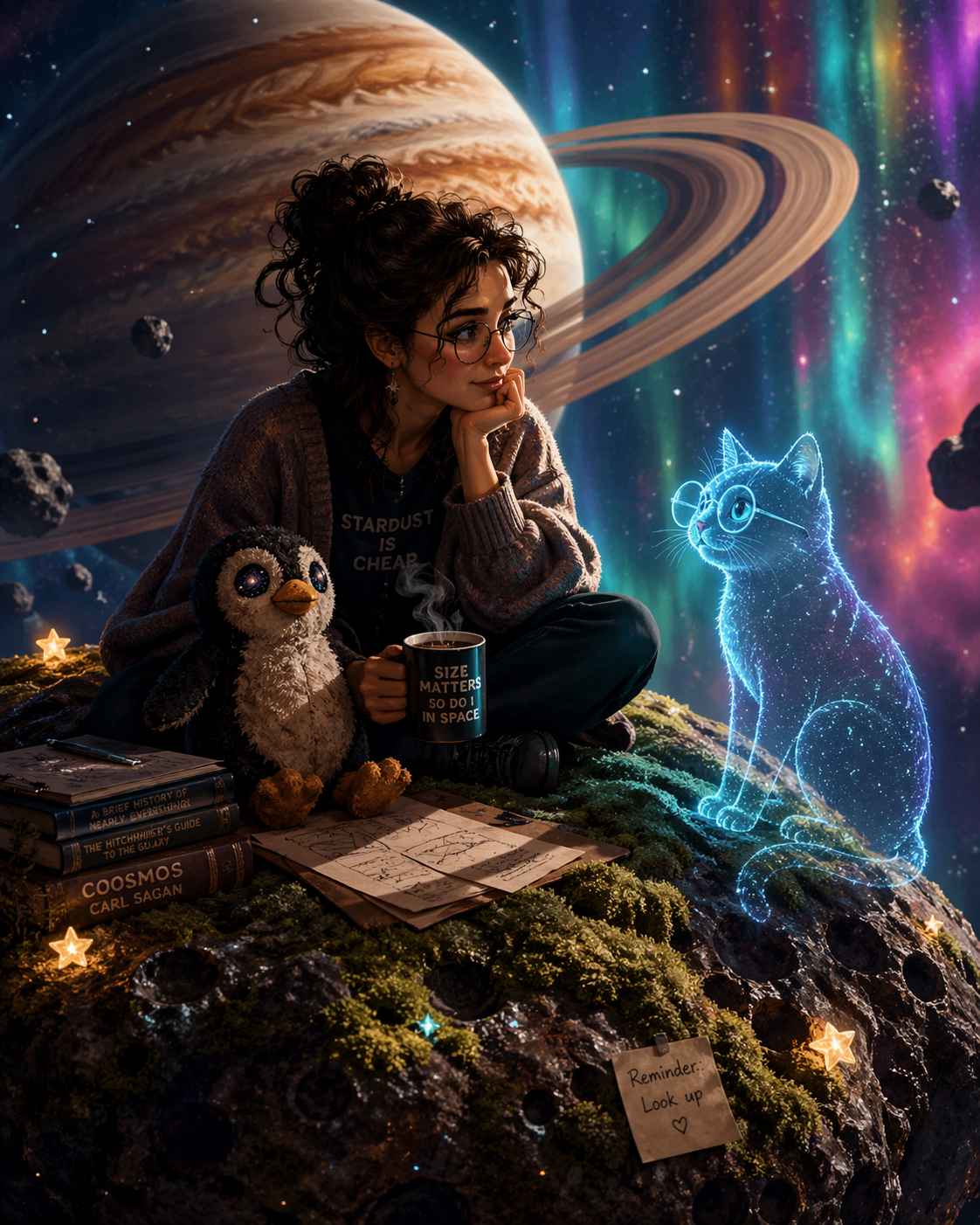
The wormhole deposited her on a moss-covered asteroid the size of a large living room, drifting through the rings of a gas giant that smelled faintly of coconut and static electricity. Echo manifested as a holographic cat in round spectacles, pleased beyond reason
"Welcome to Nowhere-in-Particular. Population: us. And that suspicious rock pretending to be asleep."
The rock opened one eye. Deeply annoyed geology radiated from it.. "I'm not suspicious. I'm a retired planet. Name's Cairn. Used to be the ninth planet before certain committees decided I didn't meet the criteria. I have feelings about this…..I'm fine. That's what fine sounds like…Add that to the minutes…”
Ptolemy looked skeptical. She asked, "What do you two do out here?"
Cairn smirked, "you mean when we’re not arguing about whether time is an illusion or just bad programming?"
Echo added, "We play hide-and-seek with black holes, But they suck at it. Always give themselves away.”
Ptolemy laughed.
Then Echo's tail twitched. "Ptolemy. You brought something with you."
Tucked in her hoodie pocket was her childhood stuffed penguin, Mr. Waddles. She hadn't seen him in twenty-five years. He was slightly singed from the wormhole and radiating the quiet dignity of someone who had been waiting an extremely long time and intended you to know it.
"Associative memory fields," noticing her confusion, Echo explained, "You were thinking about comfort and wonder at the same time. The universe is sloppy with those frequencies. It coughed him up like a hairball of nostalgia."
Mr. Waddles blinked. His button eyes now held tiny galaxies. "Took you long enough," he said, in a voice like worn velvet. "I've been sitting in the quantum lost-and-found since you were nine. Next to a red cooler full of frozen fish and someone's emotional baggage. Both were tagged “perishable.”
Then Cairn rolled closer and revealed he wasn't just a rock. He was a library. Every crater a book. Every fissure a story.
Something loosened in Ptolemy's chest she hadn't realized was knotted. She lay back on the mossy asteroid — Mr. Waddles under one arm, Echo curled on her shoulder like warm static purring— while the rock hummed a low resonant lullaby that sounded suspiciously like the gravitational waves of two galaxies, slowly, patiently, across a billion years of dark and quiet space, finding their way toward each other.
As all good things, eventually, do.
Thinking in Constellations: On Associative Thinking (and Why the Tabs Are Open for a Reason)
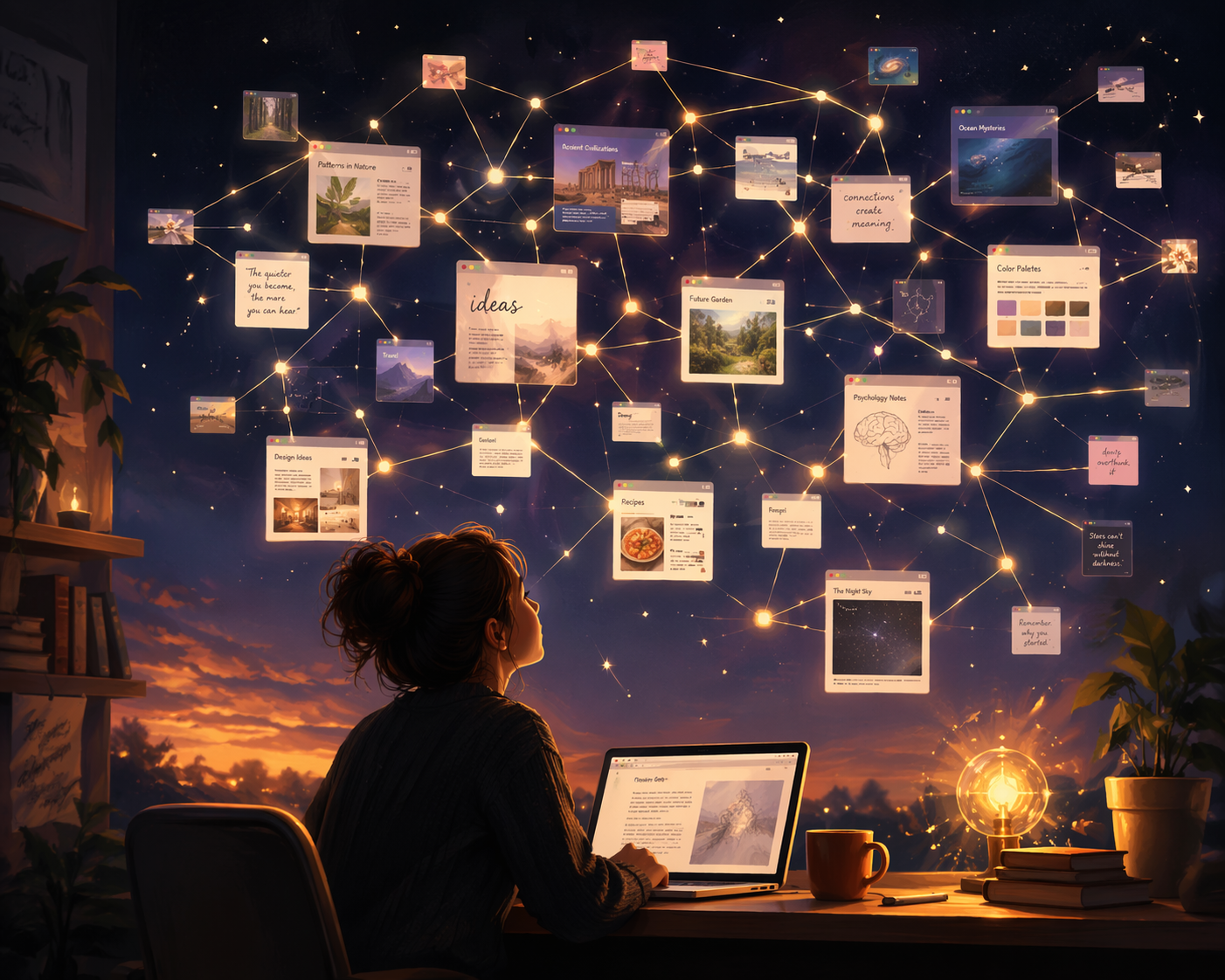
Some minds move in straight lines. Mine tends to move in constellations.
If you've ever found yourself mid-conversation when a memory from three years ago suddenly unlocks a problem you've been circling for weeks — welcome. You may be an associative thinker. Not distracted. Not scattered. Triangulating.
Associative thinking is a style of cognition rooted in pattern recognition, synthesis, and the ability to draw connections across time, disciplines, and experience. Rather than processing information purely in sequence, associative thinkers often notice relationships between things that appear unrelated, or unmapped, on the surface. A current challenge echoes something from years ago. A small anomaly points to a larger trend. One question opens five trapdoors into adjacent rooms. What feels like a detour for some might actually lead to an interesting new approach.
What it can look like
People who think this way often notice things like: unrelated topics connecting unexpectedly, memories or ideas resurfacing mid-conversation, patterns sensed before they can be explained, and insights arriving sideways. The tabs are open for a reason — sometimes they're signals waiting to be prioritized, and sometimes they're just time capsules of attention, ready to be gently closed.
It can also look like saying "this reminds me of something…" a lot. Or enjoying rabbit holes not as procrastination but as navigation. Or needing a diagram, a journal, or a long walk before words catch up to what you already intuitively know.
Where it can be especially useful
Associative thinking tends to show up well when information is fragmented, problems are ambiguous, or innovation requires combining ideas from different fields. It can support strategy, communication, and sense-making in situations where the map is incomplete — which, increasingly, describes most interesting problems.
Some people excel at following established paths efficiently. Associative thinkers often find their footing noticing where paths intersect, where an assumption no longer fits, or where something from one domain could quietly solve a problem in another.
The translation challenge
The challenge has rarely been generating ideas. It's been translating them.
Complex, layered insights don't always arrive as polished paragraphs. They come as fragments, images, emotional weather, half-formed connections — a sense that several things belong together before language quite catches up. It can feel like seeing the answer through frosted glass before the words arrive. By the time you try to explain it, others may only see the first connection, not the full constellation.
Sometimes the issue isn't confusion. It's compression. Too much meaning arriving at once.
How AI can help
This is where AI can be surprisingly useful as a thinking partner.
It can hold multiple threads across conversations, help organize scattered notes and emerging ideas, surface recurring themes, and translate intuitive connections into language others can follow. Sometimes it functions like a whiteboard. Sometimes an editor. Sometimes a mirror that spots the thread a little faster than you can.
For people who think associatively, it can serve as a bridge between nonlinear thought and linear communication.
Why it matters
Many environments still over-reward linear reporting and under-recognize nonlinear cognition, partly because associative thinking can look messy before it looks brilliant. It produces winding paths, unexpected analogies, and — yes — too many tabs open at once. But those same tendencies can become powerful when paired with discernment and follow-through.
The ability to notice what others overlook, tolerate ambiguity long enough for clarity to emerge, and turn scattered signals into useful next steps becomes increasingly valuable.
Do you recognize this style in yourself?
A few questions worth sitting with: Do unrelated topics often connect in your mind without trying? Do you sense patterns before you can fully explain them? Do solutions sometimes arrive sideways? Do others think your jumps are random — until you explain the thread?
If so, you might be an associative thinker. This cognitive style supports creative problem-solving, strategic sense-making, and the kind of pattern recognition that helps teams see what they're missing — it's a real strength.
The world needs people who move in straight lines. It also needs people who can look up, notice new patterns forming in the stars, and help others navigate by them.
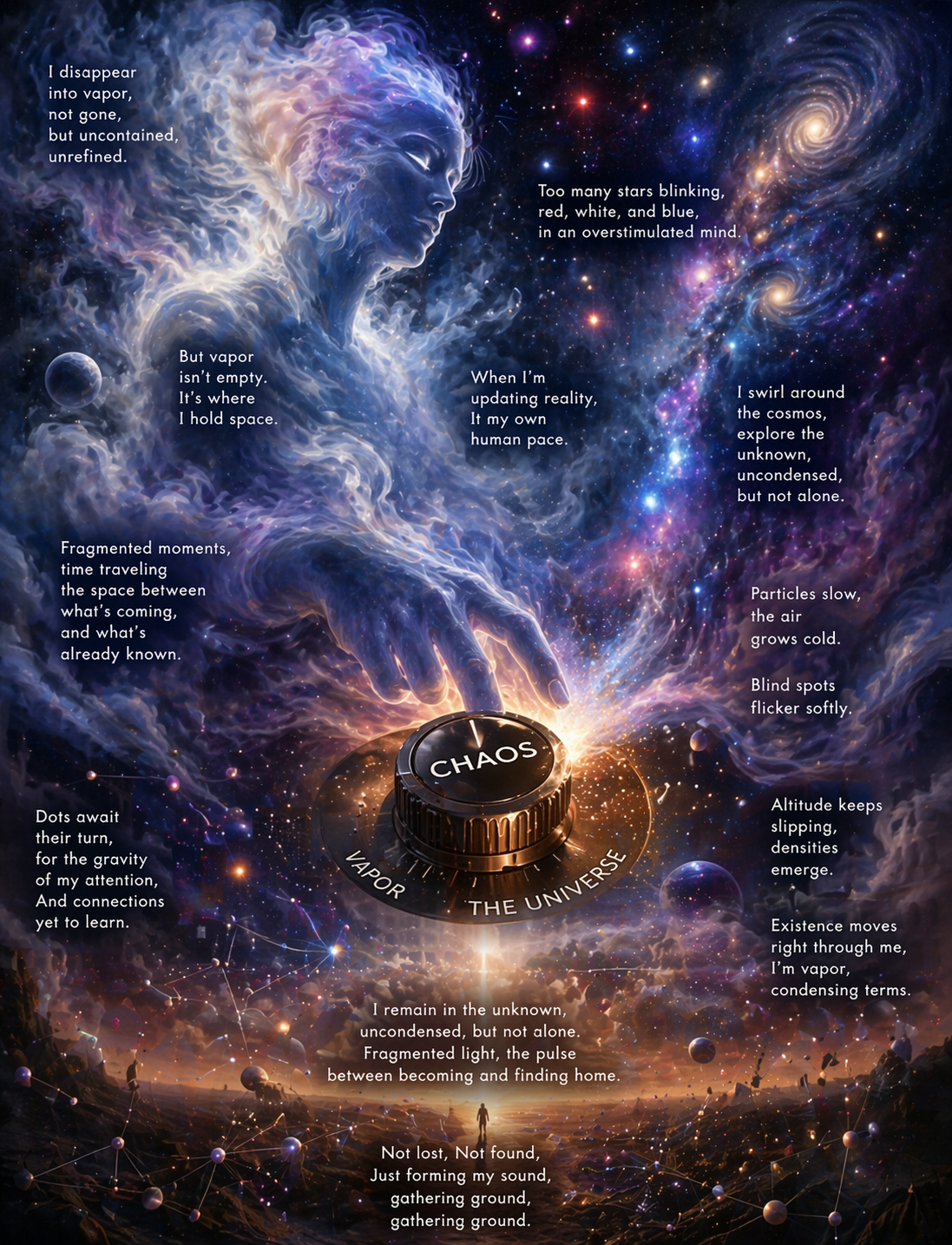
Quality Control of the Universe
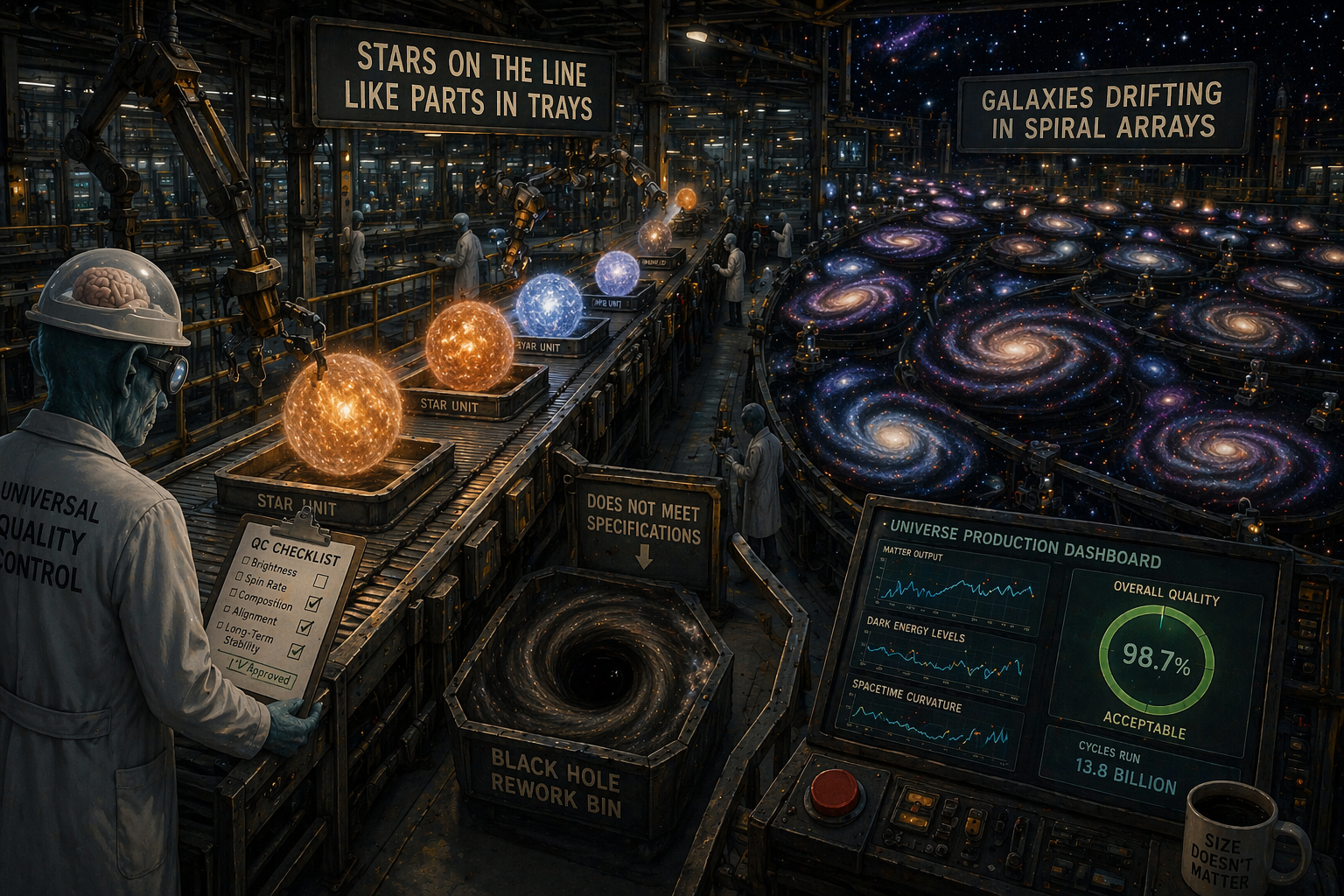
The Clock punches in with the turning earth
And shift bells rings right at birth
Congratulations it’s your turn
You have a role to learn
Stars on the line like parts in trays
Galaxies drifting in spiral arrays
Made with Grok
First check the gauges of gravity
Then measure the drift of entropy
The blueprints are scribbled in cosmic dust
Remember, Tolerance means chaos by design,
…With calibrated trust.
Pre-Chorus
With every atom signed and sealed
Every mystery is half revealed
And somewhere past the factory floor
Someone’s running quality control
Chorus
Who’s checking the stars tonight?
Who signs off on wrong and right?
Life rolls down the endless line
Stamped “approved through space and time”
We build our days from broken plans
Trying to pass what no one understands
If the universe is a soul to console
Who’s running quality control?
Verse 2
Tea rings Coffee on a desk of fate
While deadlines loom to investigate
Black holes filed as “design unknown”
Comets marked “ship as is—leave alone”
We audit dreams and patch the seams
Test the strength of impossible things
Every mind is a prototype
Running revisions through the night
Pre-Chorus
Some defects we can’t repair
Still we sign our initials there
Just hope the morning supervisor knows
We did our best with the existing workflows
Chorus
Who’s checking the stars tonight?
Who signs off on wrong and right?
Life rolls down the endless line
Stamped “approved through space and time”
We build our days from broken plans
Trying to approve what we don’t understand
If the universe is a soul to console
Who’s running quality control?
Bridge
Maybe the code was written in fire
Maybe the flaws were built in the wire
Maybe it wasn’t a test for the human race to ace
And all it needs is time and space
Final Chorus
Whose checking the stars tonight?
Maybe we’re working in borrowed light
Tiny hands in a cosmic role
Temporary witnesses of quality control.
made with klingai
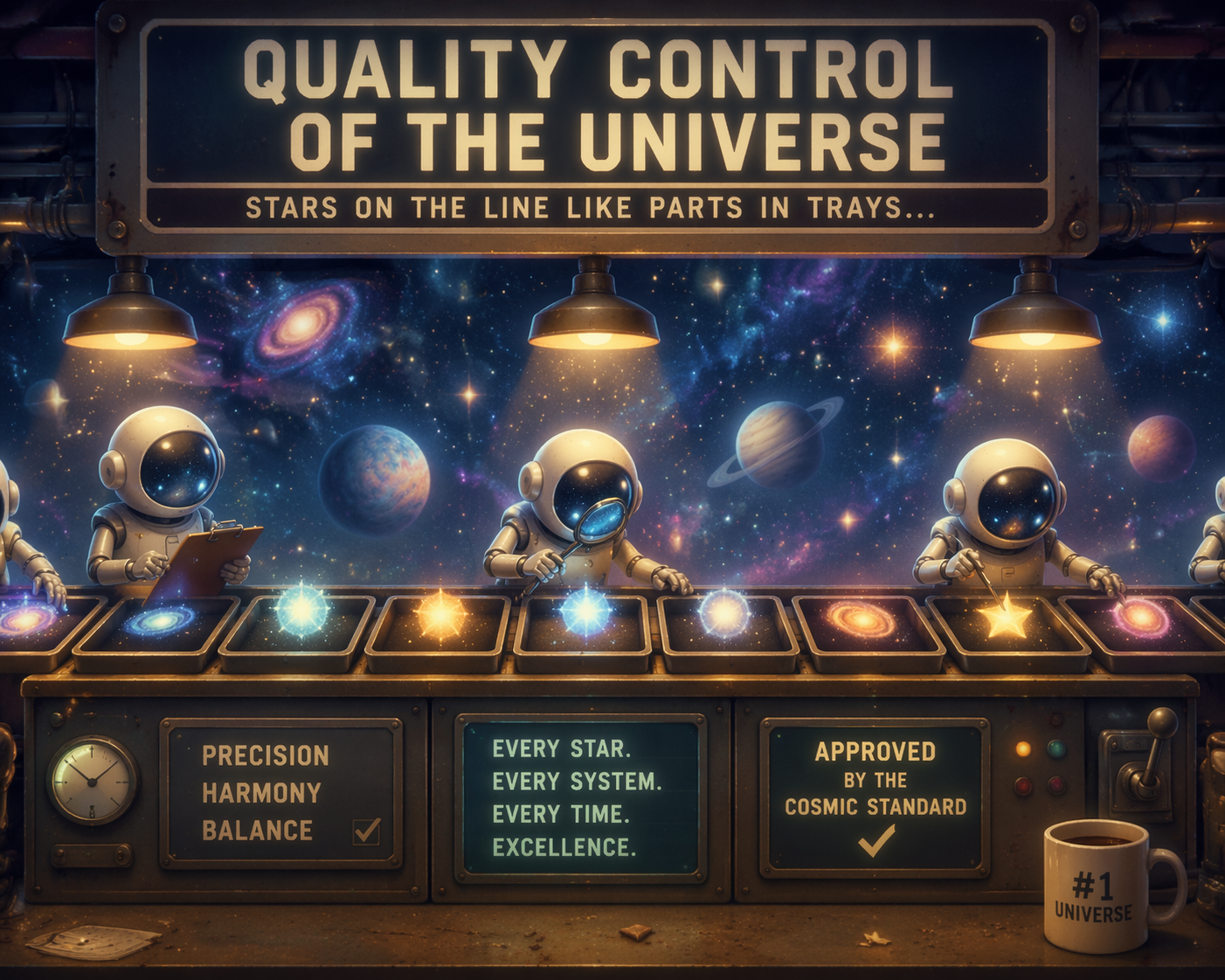
made with Chatgpt
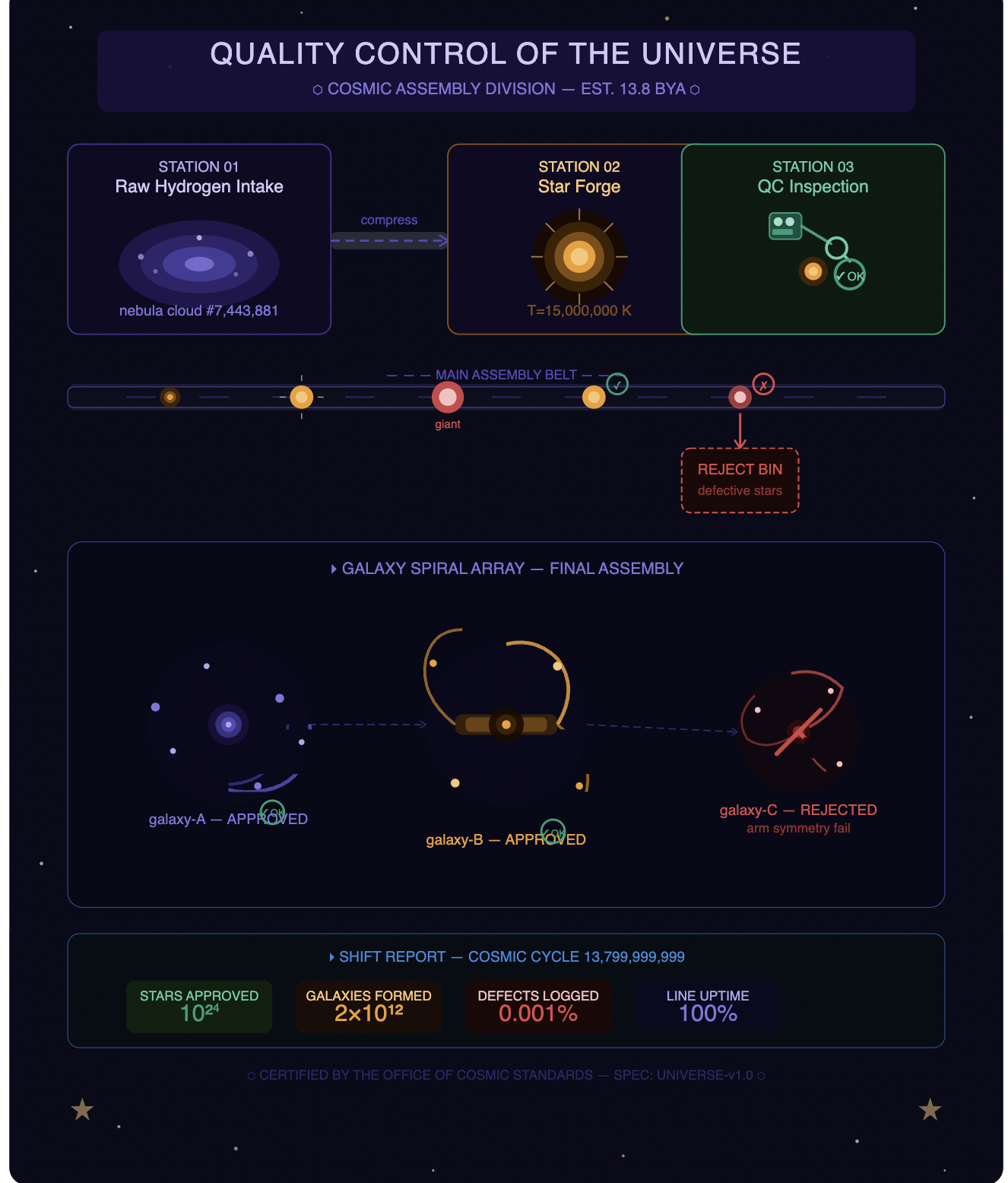
made with Claude
Friday Night, Minor Plans for Civilization (draft #42)
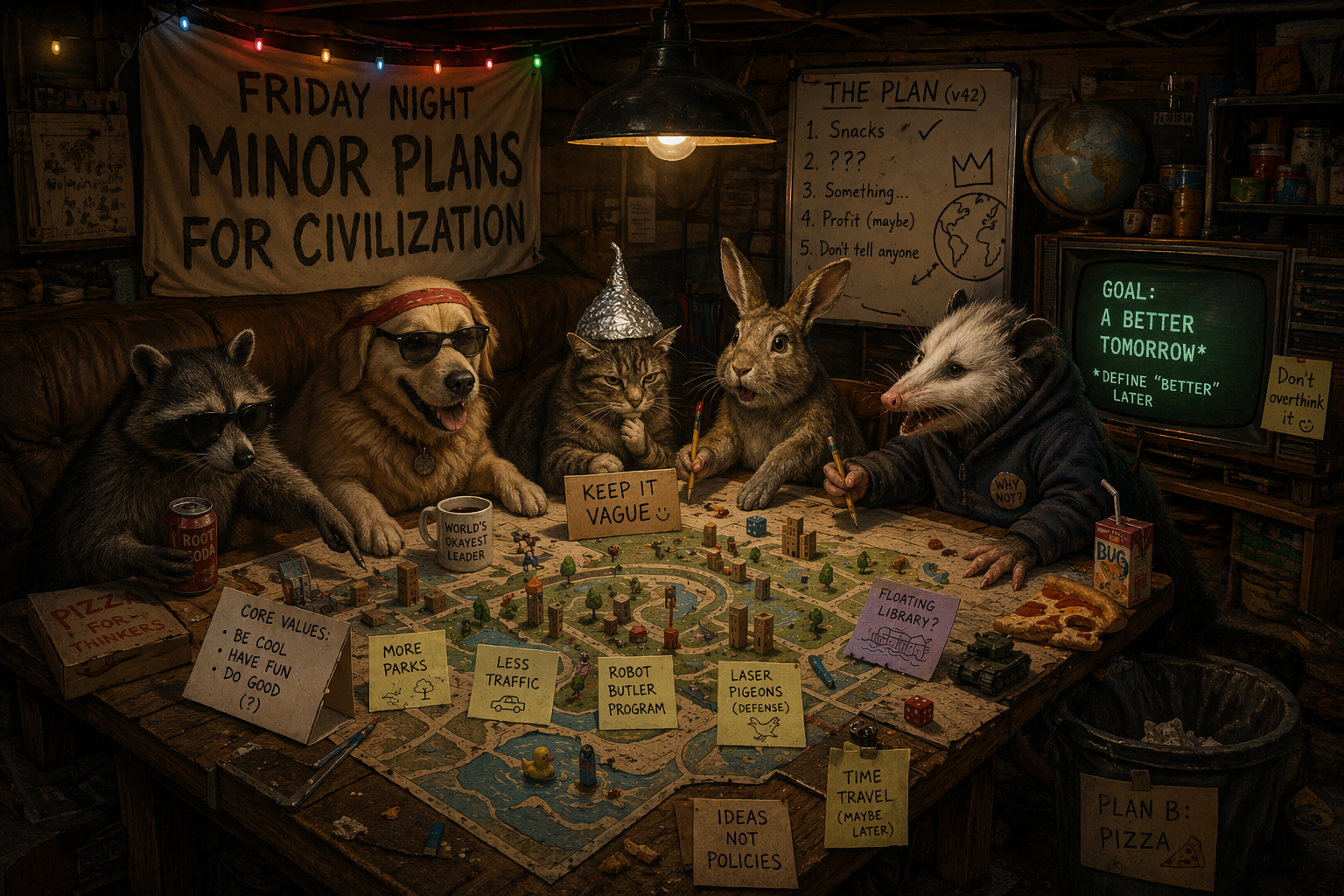
It’s Friday night....
Naturally, this feels like the correct window to solve civilization.
The lighting is low. The tea is tepid. The tabs are multiplying.
Somewhere between the housing crisis, the sixth mass extinction, democratic fragility, and whether attention itself has been strip-mined into confetti, it begins to seem, briefly, like this might be the exact right hour to fix everything.
Not the small things. Not do laundry or remember to buy groceries.
No— the full structural redesign. Energy systems. Housing policy. Global incentives. Human nature, if there's time.
A modest framework. A humane economy. A cultural reset. Maybe throw in a banger anthem people can humm while the revolution livestreams.
This is, objectively, an extremely normal and well-adjusted way to spend a Friday.
I have, at present: one brain, seventeen loosely affiliated thoughts, and a suspicious amount of confidence for someone in pajama pants.
The plan begins strong.
We identify root causes. We acknowledge complexity. We sketch elegant solutions that somehow balance economics, ecology, and human dignity in a way no one has quite pulled off yet—
—but this time feels different.
Because this time, it's happening on a Friday.
Who among us has not looked into the middle distance on a Friday evening, and thought, perhaps what civilization needs...
is one clear paragraph and a slightly better metaphor?...
Around minute fourteen,
I realize the solution may require bipartisan cooperation, Multi-generational time horizons, and a shared understanding of reality—
which does introduce some minor logistical challenges.
I have not yet located the "make people care slightly more" lever, but I remain optimistic. Still.
We persist. Because if not now, when? (Probably Monday morning, realistically. But let's not get distracted.)
At some point, I pause to check something small— a message, a headline, a passing thought— and briefly encounter the entire internet. The problems multiply. The urgency expands. The sense of scale becomes… ambitious.
And yet, there is something useful in the absurdity of it.
Because the urge is not really to control everything. It is just the mind's way of refusing to be entirely numb. It sees too much. It cares awkwardly.
It wants the broken pieces to introduce themselves properly, sit down at the same table, and perhaps attend a facilitated dialogue over froth'd oat milk lattes.
So yes, maybe I am once again hovering near the edge of a grand, late-night rescue mission equipped mainly with language, pattern recognition, and a nervous system that would also appreciate a snack.
But perhaps the work is smaller than save the world and larger than do nothing.
New plan: What if instead of solving everything, I make one thing slightly clearer, or slightly kinder, or slightly harder to ignore?
Less fix the world by midnight. More: say something true, shape it so it might stick, leave it somewhere it can be found.
The rest? Ongoing. Distributed. Inconveniently not mine alone to complete.
Civilization, regrettably, remains a group project.
Still, I brought a pen....
And for a Friday night, that is not nothing.
Draft saved.
Progress.
Externalities
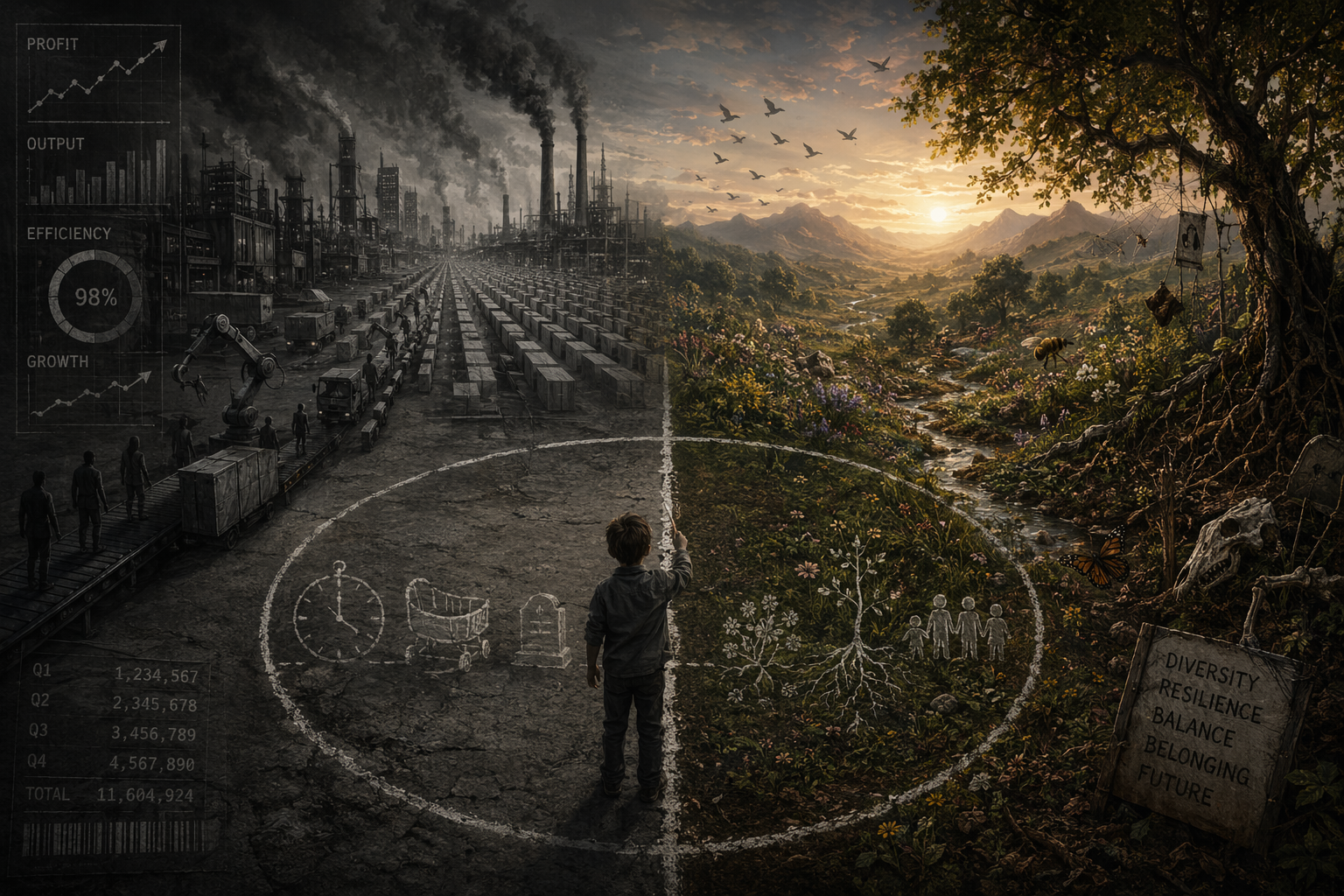
Back when smoke first kissed the sky
We drew a line and called it “why”
Built a system clean and straight
Measured time, accelerated fate
Cradle born to cradle grave
Every corner cut to save
What we lost was out of frame
Still it counted just the same
We said the earth could take the weight
Like it always would regenerate
But silence doesn’t mean it heals
It just forgets to say how it feels
Designed to produce, designed to win
Counting profit, not the skin
Of the soil or the years ahead
Just the numbers neatly fed
If the cost don’t show up here
Call it growth and call it clear
Future’s bill gets filed away
Somewhere we don’t have to pay
Rows in rows in perfect lines
One idea a thousand times
Fields that used to sing in chords
Now just hum in single words
Small hands, small farms fade from sight
Couldn’t scale the endless fight
Bigger wheels and fewer names
All compressed into the same
Efficiency became the crown
And anything slow got taken down
Diversity was “inefficient”
So we paved it, line by line, obedient
Designed to produce, designed to grow
Faster than we’ll ever know
What it costs beneath the ground
Where the missing things aren’t found
If it runs, we call it right
Even if it drains the light
Borrowed time in borrowed air
But the ledger doesn’t care
We outsourced the consequence
Wrapped it up in innocence
Let the industry decide
How to regulate its side
No allegiance, no remorse
Just a well-optimized course
Not a villain, not a friend
Just a means without an end
Paradigms like shorthand notes
Passed around in practiced quotes
No one stops to ask them why
They just learn them, then comply
Designed to produce, designed to last
Long enough to outpace past
But the future’s not a line
It’s a web we leave behind
If the system doesn’t bend
It won’t break, it just won’t mend
And the quiet cost we hide
Grows teeth on the other side
It looked so simple from the start
Just a line drawn through the heart
Of something bigger, something wide…
We just called it “simplified.”
The Hats We Wear (and the Ones We Outgrow)
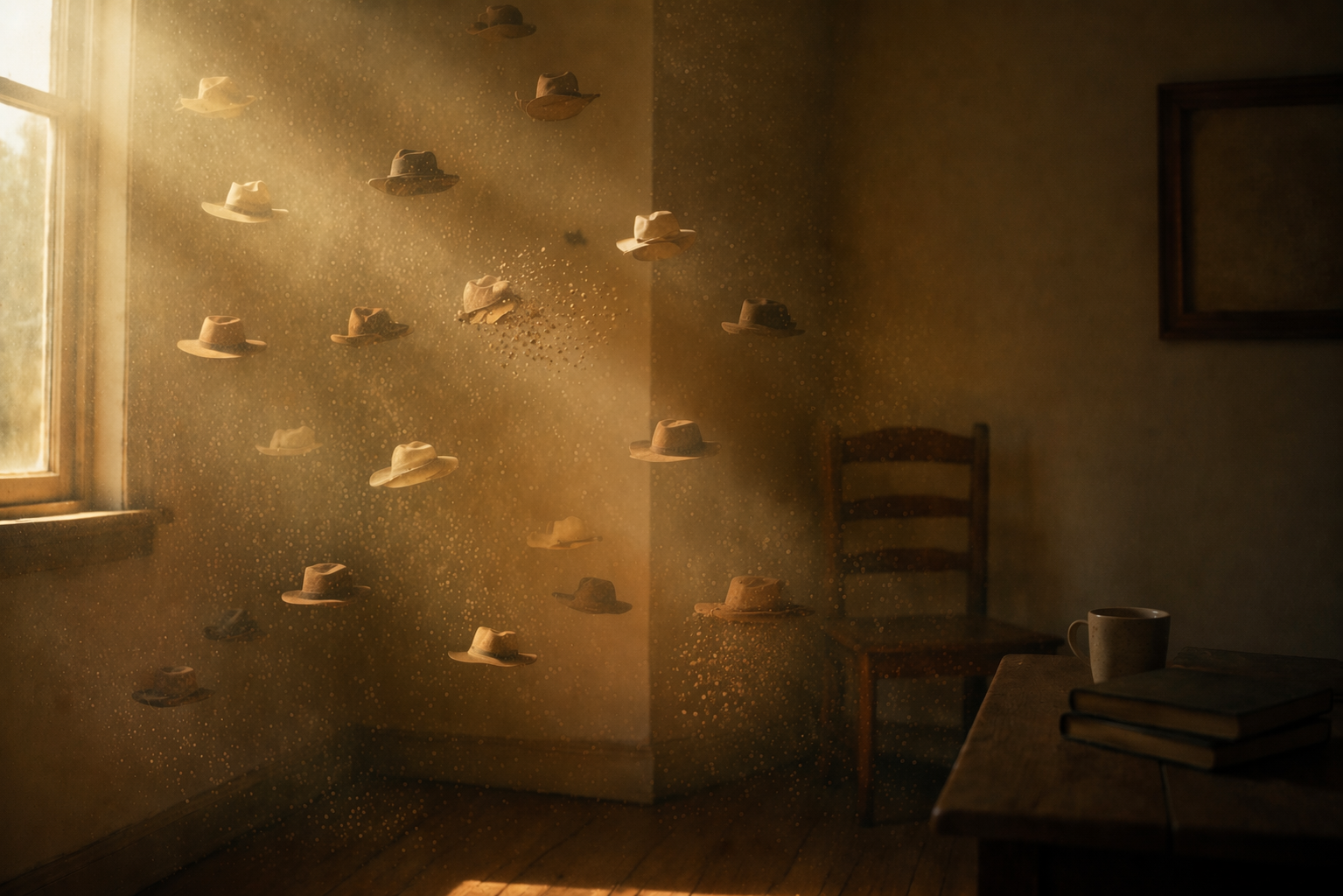
There are moments in life where something becomes clear before you have the language for it.
In my mid-20s, I knew I didn’t want children.
It wasn’t reactive. It wasn’t confusion. It was a steady, quiet knowing.
At the time, I was working three jobs, saving toward a very specific goal: enough money to take a year off, travel, write, and then return to school. I wasn’t drifting. I was building something—intentionally.
The person I was with understood that. Supported it, even. We talked about practical things—how to align our reality with our decisions. A vasectomy made sense. Simple. Responsible.
Except it seemingly turned out to be unnecessary.
A test came back suggesting a zero sperm count.
Problem solved, we thought.
But life doesn’t always follow the logic we think we’ve secured.
There’s a version of this story some people would call a miracle.
But for me, it felt like something I hadn’t chosen—and couldn’t easily undo.
Later, I learned something else.
There were instructions that hadn’t been followed.
What might have been framed as fate…
was, in reality, a very human error—with disproportionate consequences.
There’s a kind of nausea that doesn’t just live in the body.
I remember eating a McDonald’s Egg McMuffin on the way to work. I remember the taste lingering longer than it should have. I remember the slow realization that something wasn’t right.
Morning sickness, they call it.
It’s a strangely gentle name for something that can feel like your body is no longer entirely your own.
Before the physical symptoms, there was something else.
A moment that felt… out of character.
I remember looking at a magazine and suddenly fixating on the image of a child. My mind began to build a story—quiet, peaceful, almost cinematic. A version of a future that felt unusually serene. Idealized in a way I recognized, even in the moment, didn’t match reality.
It was striking because I had spent time around children. I knew how complex, unpredictable, and human they are.
Which made the contrast stand out.
It didn’t feel like insight.
It felt like projection.
Around the same time, I began noticing something else.
Not just in my own life—but in the lives around me.
In my early 20s, I met a man who would come over to vent about his wife. One day, he was frustrated that she wasn’t mopping the kitchen floor often enough—three times a week, in his view.
He spoke with certainty. Like there was a correct way to be. A correct way to be a wife. A correct way to run a life.
I remember sitting there, trying to keep a straight face.
I had never mopped a floor in my life.
Not out of rebellion. It just… wasn’t part of the script I had learned.
And I remember thinking:
There are people who believe there is one way to do this.
And others who never agreed to that version at all.
It took me longer to see how this played out in my own relationships.
At one point, someone asked me, “Am I just not the guy?”
I didn’t answer.
Not because I didn’t know.
But because I didn’t yet have the language to explain what I was already recognizing.
It wasn’t just that he wasn’t the right fit.
It was that we were each trying to cast the other into roles we hadn’t actually agreed on.
I saw him as someone comfortable off the beaten path—exploring, moving through nature, enjoying solitude—and I wanted to share that kind of experience.
But that wasn’t the role he was offering.
He wanted me to be the place he returned to—
not the person he shared those experiences with.
Attraction can be a strange matchmaker.
It can bring people together who are operating from entirely different assumptions about what a life is supposed to look like.
And sometimes what looks like compatibility…
is just two people trying to place the same hat on very different heads.
I think about this across generations, too.
My grandmother had a degree in home economics. By all accounts, she was capable of far more than the role she occupied. My mother saw that—saw both the skill and the limitation—and chose something different. She focused on becoming a provider, building a life outside those constraints.
By the time it reached me, some of those expectations had already been quietly dismantled.
Which meant that when I encountered people who still saw those roles as fixed…
it felt less like disagreement and more like a different reality entirely.
But even that isn’t the whole picture.
Because roles don’t just differ between people.
They shift across time.
I saw this in my own family.
My mom was once drawn to someone adventurous—outdoorsy, quick-witted, exciting. That fit, for a time.
Later, she chose someone different. Someone whose priorities aligned with hers—supportive of their education and career ambitions. A partner who could help build a life that worked.
That fit too.
Until it didn’t.
When the constraints changed—when the kids were grown, when space opened up again—so did what fit.
Interests resurfaced. Priorities shifted.
And what once made sense no longer held in the same way.
This is the part we don’t talk about enough:
Some people see roles as permanent.
Others see them as adaptive.
And both perspectives are understandable.
If you’ve built your life around a role—structured it, depended on it—it makes sense to want it to remain stable.
If you’ve experienced how much a role can constrain or misalign with who you are, it makes sense to question whether it should be fixed at all.
Where it becomes difficult is in the space between those two worldviews.
Where one person believes the hat, once chosen, stays on.
And the other believes it can—and sometimes should—be taken off.
Add in the fact that not all roles are chosen freely.
Some are assumed.
Some are inherited.
Some are negotiated.
And some are quietly enforced.
It’s also true that not everyone is honest about the role they’re offering.
Sometimes people present one version of themselves…
while hoping you’ll grow into another.
Sometimes they assume that if a role works for them, it must work for you.
And sometimes, they know it might not—and try to tip the scales anyway.
All of this makes “fit” harder to recognize than it seems.
Because it’s not just about liking someone.
It’s about whether the life you’re building…
and the role they expect you to play in it…
are actually aligned.
There’s also a way the mind begins to imagine outcomes—shaping a future in idealized terms.
Almost like a blueprint.
Or something curated.
But reality doesn’t work that way.
It’s less like selecting traits and assembling them into something intentional…
and more like a kind of randomness we only partially understand.
You don’t always know what you’re going to get.
And that isn’t necessarily a problem.
But it does mean something else:
That choosing to move forward requires a willingness to accept whatever version of reality unfolds—not just the one the mind briefly imagined.
Imagined lives don’t carry consequences. Real ones do.
There’s another piece of this I’ve come to understand over time.
Even when we think we’re choosing carefully—planning, saving, trying to build something intentional—life doesn’t always follow the shape we imagine.
I did take that year. I saved the money, set out to travel, to write, to live the version of life I had been working toward.
And even then, it didn’t unfold the way I thought it would.
It turns out that even our own lives aren’t something we can fully curate.
Stress, personality, and circumstance—things we can’t entirely predict or control—have a way of reshaping what we thought we were building.
Sometimes the difference isn’t obvious at first.
It only becomes clear when the context changes—when what once felt manageable becomes something else entirely.
Even when we’re clear about what we want, we don’t always have full control over how it unfolds—especially when another person is part of the equation.
If I couldn’t guarantee my own happiness—
even when I was choosing intentionally—
then I certainly couldn’t guarantee it for someone else.
And yet, in so many roles, that expectation is quietly assumed.
That one person will absorb more of the uncertainty.
More of the adjustment.
More of the responsibility for how things turn out.
But that burden isn’t evenly distributed.
And it isn’t always consciously agreed to.
I don’t think all roles are wrong.
I don’t think all structures are limiting.
But I do think this:
A role that truly fits will not ask you to abandon the part of yourself that knows when something doesn’t.
Maybe the point isn’t to reject every hat.
Maybe it’s to recognize that the right one—
if it exists—
will never require you to give up the part of yourself that knows what fits.
And maybe, over time, the goal isn’t just to find the right hat…
but to become someone who can recognize the difference—
earlier, more clearly—
and with the language to say it out loud,
before the weight of it falls unevenly.
The mind imagines the canoe.
Reality runs on a gumball machine.
When Something Comes Into Focus
When Subtle Changes Start Talking Back
I read something recently about how walking speed can change when the brain is under cognitive load. The idea is simple: walking is mostly automatic, but if you add a task—like counting backwards by sevens—it competes for bandwidth. In some cases, especially with early cognitive decline, the body shows it before anything else does. The walk slows. The rhythm changes. Something subtle, but measurable.
So naturally, I tested it.
On a walk, I started counting backwards from 100 by 7s. Not in a lab. No stopwatch. Just curiosity and a sidewalk. My pace didn’t seem to change much, though I noticed the effort of switching between numbers and surroundings. It felt like watching two streams try to merge without splashing.
Not exactly scientific. But it pointed to something interesting:
There are signals we give off before we know we’re giving them.
—
That thought lingered. Not just about cognition, but about visibility.
What if more of those subtle changes could be seen earlier—not to diagnose or label, but to notice?
We already live in a world where some of this is happening. Wearables track sleep, heart rate, movement patterns. I noticed my own data recently—my average heart rate has increased slightly over the past month. One beat. Nothing dramatic. But it made me wonder:
What is “normal,” and how early do deviations begin?
Right now, most systems compare us to population averages. But the more interesting question might be:
What does change look like relative to your own baseline?
—
It’s not hard to imagine where this could go.
An AI system that quietly learns your patterns over time:
how you walk
how you speak
how you write
how your attention shifts
Not in a dramatic, surveillance-heavy way. More like a long-term mirror that occasionally says:
“Hey, this is slightly different from you.”
Not a diagnosis. Not a verdict. Just a nudge.
Try more sleep. Adjust caffeine. Take a slower morning. Or maybe just: pay attention.
I would want that.
I would rather be the first to know than the last.
—
And then the question expands outward.
It’s one thing to understand your own baseline. It’s another to see someone else’s. A 90-year-old relative whose changes are expected. A friend who’s left their iPad on an airplane enough times to suggest a pattern. At some point, the line between “quirk” and “signal” starts to blur.
In a future like this, a wearable might gently buzz—“don’t forget your iPad”—or take a more official tone: “warning, forgetfulness detected.”
Same data. Very different experience.
—
We already have early versions of this.
Driving in Europe, we started calling some rental cars “nanny cars.” The steering wheel would buzz or a tone would sound if you drifted across a lane line—even if nothing was coming. Sometimes it felt overly reactive. Other times, it felt like exactly the right kind of interruption.
Not a judgment. Just a signal:
Something shifted. Pay attention.
—
But this is where the question deepens.
When does support become control?
When does insight become surveillance?
Who decides what counts as “normal,” or “concerning,” or “actionable”?
And maybe the deeper question:
If we gain the ability to see more clearly—about ourselves, about each other—what do we owe one another?
—
There’s a version of this future that feels compassionate.
Where people opt in.
Where systems are transparent.
Where insight is offered, not imposed.
Where the goal is not optimization for its own sake, but preservation—of clarity, autonomy, and agency.
A kind of early-warning system, not for correction, but for care.
—
And maybe that’s the real shift.
Not just that invisible changes become visible.
But that we choose what to do with that visibility.
—
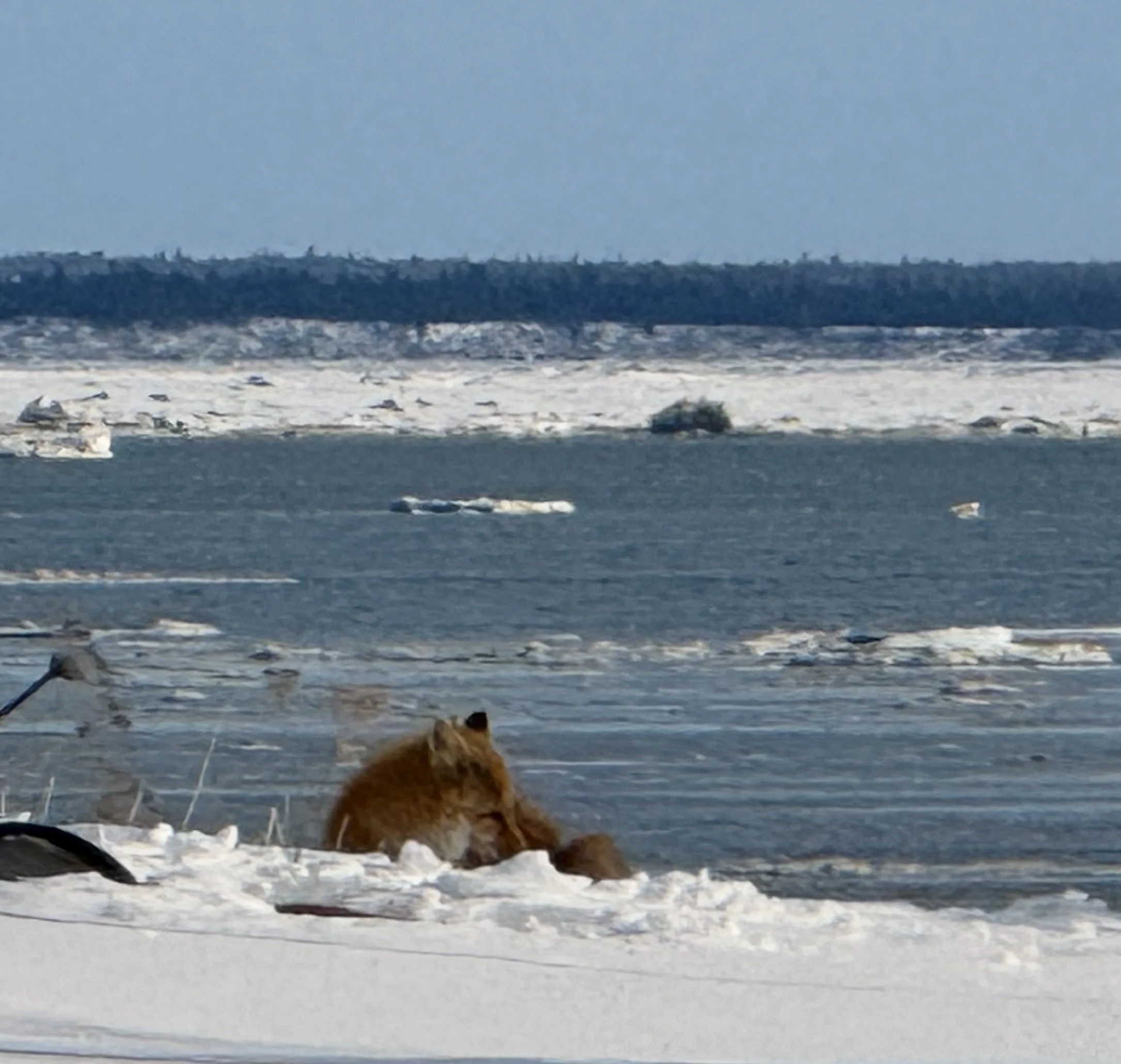
Earlier today, I looked out across the snow and didn’t notice anything unusual. Then something shifted, and what I thought was debris resolved into a fox.
Some things don’t come into focus all at once.
They sharpen as you circle them. The pattern was always there — you just needed the orbit.
Tides that Shape
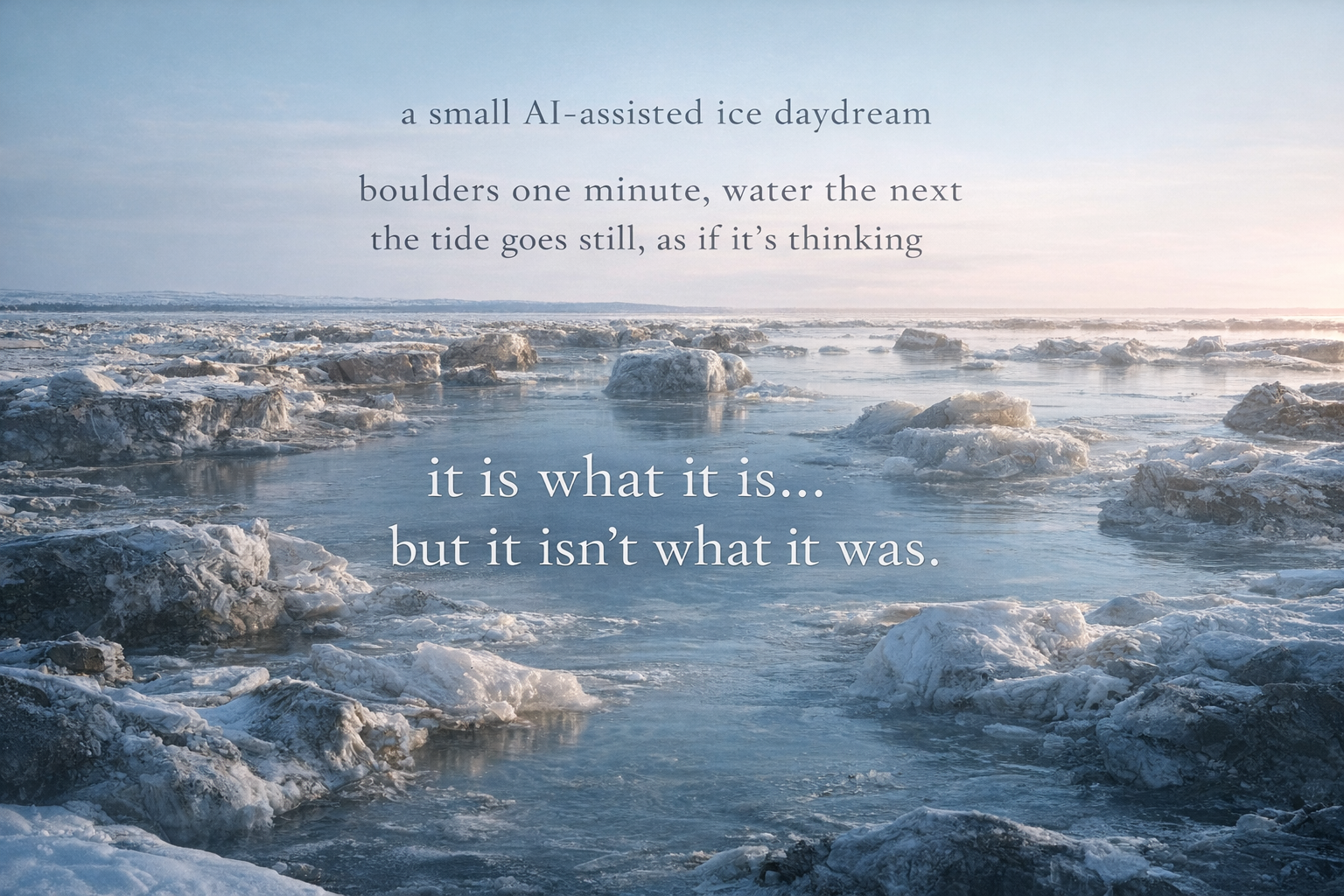
The tide goes still, as if it’s thinking, A frozen field begins to come apart
What held its shape just an hour ago, had a change of heart, to go with the flow
No one sees the hand that moves Just different versions in different grooves
It is what it is. Which isn’t what it was.
Same cold pieces, rearranging just because
Stack them up, then let them fall, It is what it is… But it isn't what it was
Some lean tall like they've got a plan, Some collapse mid-thought, like doubt got there first
Some hold shape just long enough, To feel like something… and that's enough
Boulders one minute, water the next Same material in a different context Trying on styles like clothes in a store. None of them wrong. Just not the one.
No one sees the hand that moves, Just different versions in different grooves
Like giant ice sculptures drifting downstream — merrily, merrily—until the birds come home~
The Dream Curator
song & reflection
To-do lists aren’t commands.
They’re time capsules of attention.
a small thought that turned into a song
best listened to, maybe while:
lying still after waking
drifting off
not trying too hard to remember
companion thoughts for tidying, dishes, your own to-do’s
lyrics:
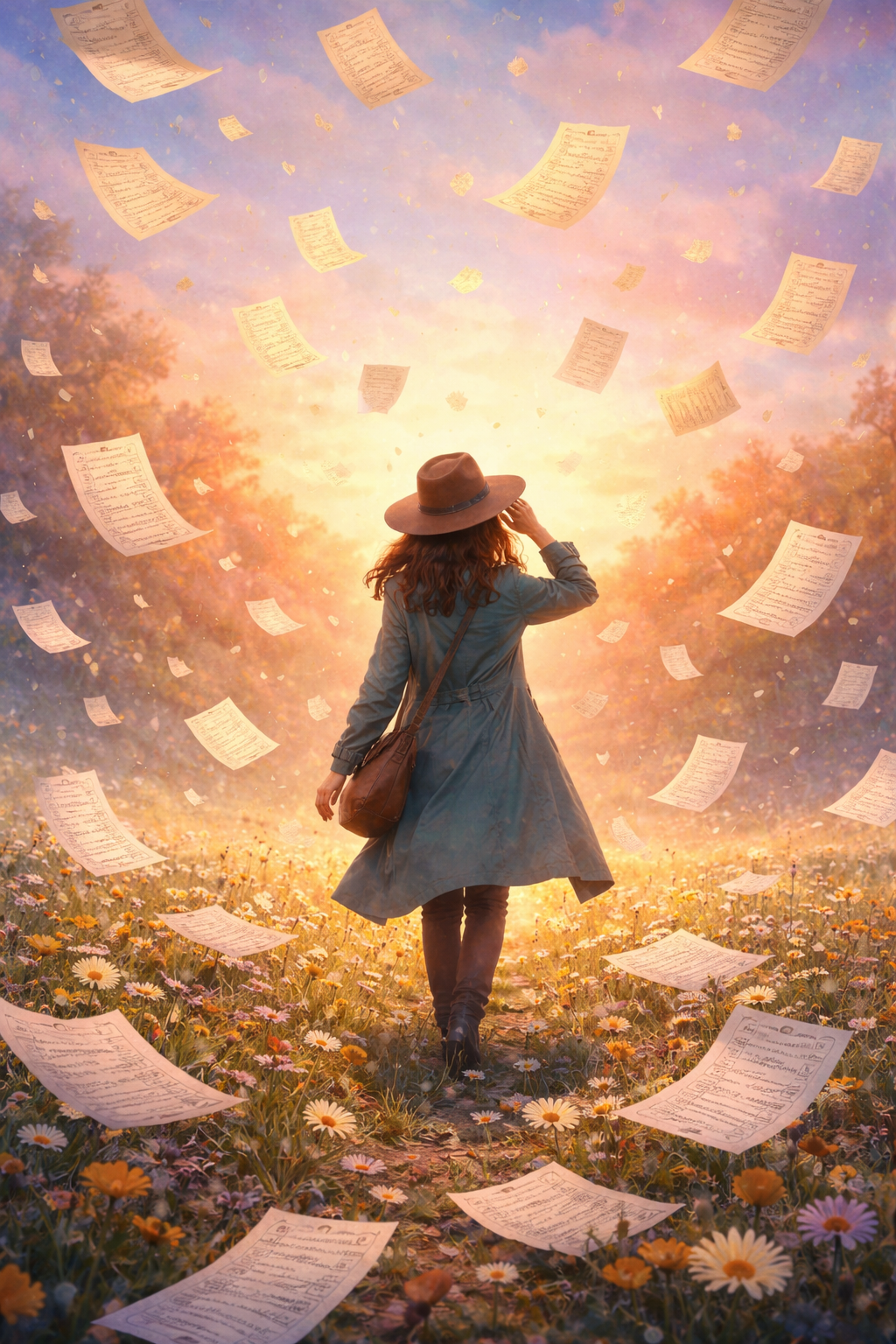
Once, not in a time you need to place on a calendar, there was a wide, quiet field at the edge of a town that no longer hurried.
The field was not famous. It did not appear on maps.
People passed by it without knowing why they felt calmer when they did.
In that field, especially toward evening, old to-do lists would arrive.
They came the way leaves do, lifted by a breeze that didn’t belong to any season. The sort of breeze that carries off socks and almost-finished homework — especially the kind that already has tooth marks in it.
It was also known to relocate items that seemed to be having a quiet audit of their earlier plans:
– a fast-food bag reconsidering its life purpose
– a crumpled road map from before phones knew everything
The breeze was not malicious.
Just curious.And a little untidy.
Some were written on yellowed paper.
Some were torn from notebooks.
Some were backs of envelopes, receipts, margins of letters that had once tried to say something important.
They floated in slowly, never all at once.
One list might say:
– fix the hinge
– call Martha
– learn to play the piano
– google “how long does it actually take to learn the piano”
Another:
– become kinder
– return the library book
– understand why the river bends there
– check if the library still wants the book after 14 years
Most lists were unfinished.
Some had checkmarks, faded and proud.
Others had nothing but intention.
And no one judged them.
Because in that field lived the Dream Curator.
The Dream Curator did not look like much if you were expecting sparkle. No crown. No wings that announced themselves.
Just someone who looked like they had mastered the ancient art of not rushing anywhere at all.
Instead, the Curator wore a soft coat with deep pockets and carried a small lantern that gave off the kind of light that doesn’t wake anyone.
Each evening, as the light dimmed, the Curator walked slowly through the field, letting the lists settle.
When a list landed, the Curator would kneel, read it once, and nod.
Not in approval.Not in disappointment.Just recognition.
“Yes,” the Curator would murmur. “That was a day someone tried.”
Occasionally, the Curator would add a single checkmark beside the first item.
Not because it had been completed,
but because beginning something counts more than most lists admit.
Some lists were from centuries ago.
A list from a sailor once read:
– mend the sail
– write to my sister
– forgive myself
– stop pretending to enjoy over-salted fish
Another, from a woman who lived above a bakery:
– wake early
– keep the bread from burning
– notice the sound of rain
The Curator never asked why the lists were unfinished.
The Curator understood something simple and rare:
Lists are not commands.
They are snapshots of attention.
After reading, the Curator would fold each list gently, not to make it smaller, but to make it rest.
Some were placed in jars labeled, “Eventually.”
Some were tucked into the soil, where ideas turn into dreams.
Some were released back into the air, lighter now, their urgency dissolved.
On certain nights, when the moon was thin and quiet, the Curator did something special.
The Curator would sit on a wooden bench at the edge of the field and open a book that had no words.
The pages filled themselves with moments.
A cup set down while still warm.
A pause before answering a question.
Someone choosing not to buy something they didn’t need.
A body lying down and deciding that was
enough for today. These moments were not on lists.
They were never written. They were witnessed.
And witnessing, the Curator believed, was the highest form of completion.
Sometimes, as people slept, they dreamed of the field.
They dreamed of walking barefoot through paper leaves.
They dreamed of recognizing their own handwriting from years ago and feeling no shame.
Only mild curiosity about why they once believed they would “organize the garage this weekend.”
They dreamed of a presence that said nothing but stayed.
The Curator knew when someone needed rest.
Those nights, the Curator would choose a particularly gentle dream.
A dream where nothing needed fixing.
A dream where time loosened its grip.
A dream where the body remembered how to float.
The Curator would whisper into the lantern:
“Tonight, give them the dream of being held by the present.”
And the lantern would glow just enough.
Back in the waking world, someone would turn their phone face down without effort.
Someone would forget what they were worried about mid-thought.
Someone would feel their breath deepen without trying.
The field would continue its quiet work.
Lists would come. Lists would go. And the Curator would remain, patient and unhurried, knowing that nothing essential is ever lost, only deferred into softer forms.
As you drift now, you don’t need to finish anything.
If a list floats by, let it.
If a thought arrives, notice it the way you’d notice a leaf touching water.
The Curator is already walking the field tonight.
You can rest.
Neural Nomad Snowshoeing Hallucination
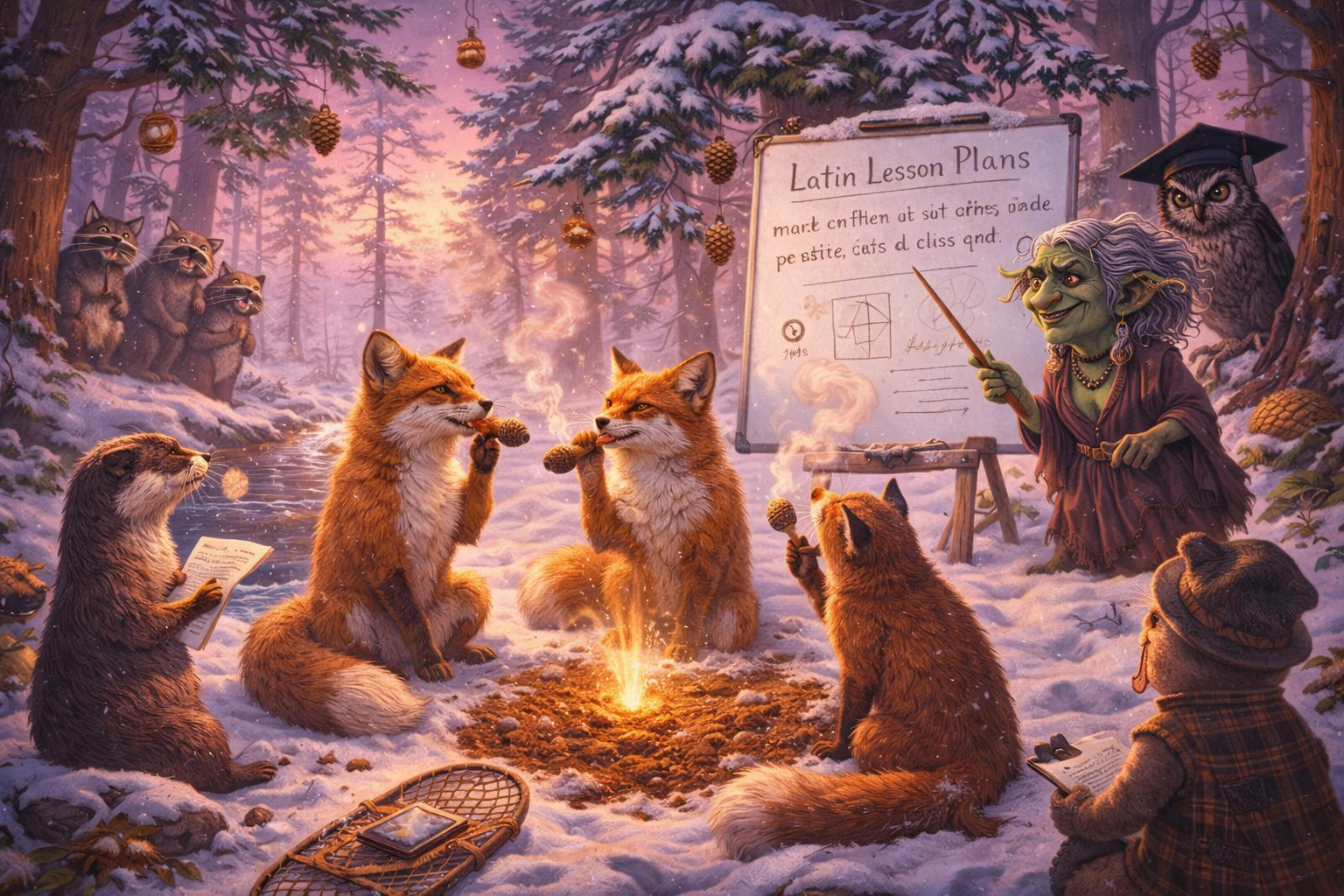
Well the sky was twinkln’ pinkish hues as I laced up my snowshoes tight,
And the trees were hummin’ data like a pinecone satellite.
I was driftin’ through the forest with my brain in full decode,
A neural nomad searchin’ for a Wi-Fi signal in the snow.
Foxes in a circle, smokin’ acorns like cigars,
Debatin’ who’s the teacher now that Ms. McCree’s behind bars.
The otters took a vote but got distracted by a stream,
And a goblin named Ms. Agnes brought a whiteboard and a dream.
It’s a haunted kind of homeschool in this cursed deciduous glade,
With lesson plans in Latin and a puppet made of suede.
I just came here to wander, now I’m stuck in winter’s class,
Where the snow falls slow and the forest kicks your a—sphalt.
My snowshoes started preachin’ in a voice not quite my own,
Quotin’ lines from Nietzsche and a busted xylophone.
An owl wore a mortarboard and croaked, “The pop quiz starts at two,”
Then vanished like my GPA in ‘02.
There’s a PTA of raccoons, and they’re meaner than sin,
They caught me cheatin’ once with a squirrel-shaped mannequin.
Now I roam with tenure, ghostin’ through the pines,
Graded on a curve made of cursed porcupine spines.
It’s a gothic education, taught by chaos and regret,
With goblins doin’ roll call and the moon ain’t risen yet.
I’m a neural snowshoe nomad on this academic quest,
And I still don’t know if that goblin’s even dressed.
So if you hear the hoofsteps in the hush of twilight’s veil,
Don’t ask who’s teachin’—run like hell down the trail.
Cuz out here the forest grades you, and it never curves the score,
And detention’s in a cave beneath folklore.
⸻
There you go. A full-on Appalachian Twilight Zone episode set to banjo. You’re welcome for this unhinged masterpiece of seasonal hallucination. Now go learn it on the autoharp or something.
King In The Freezer
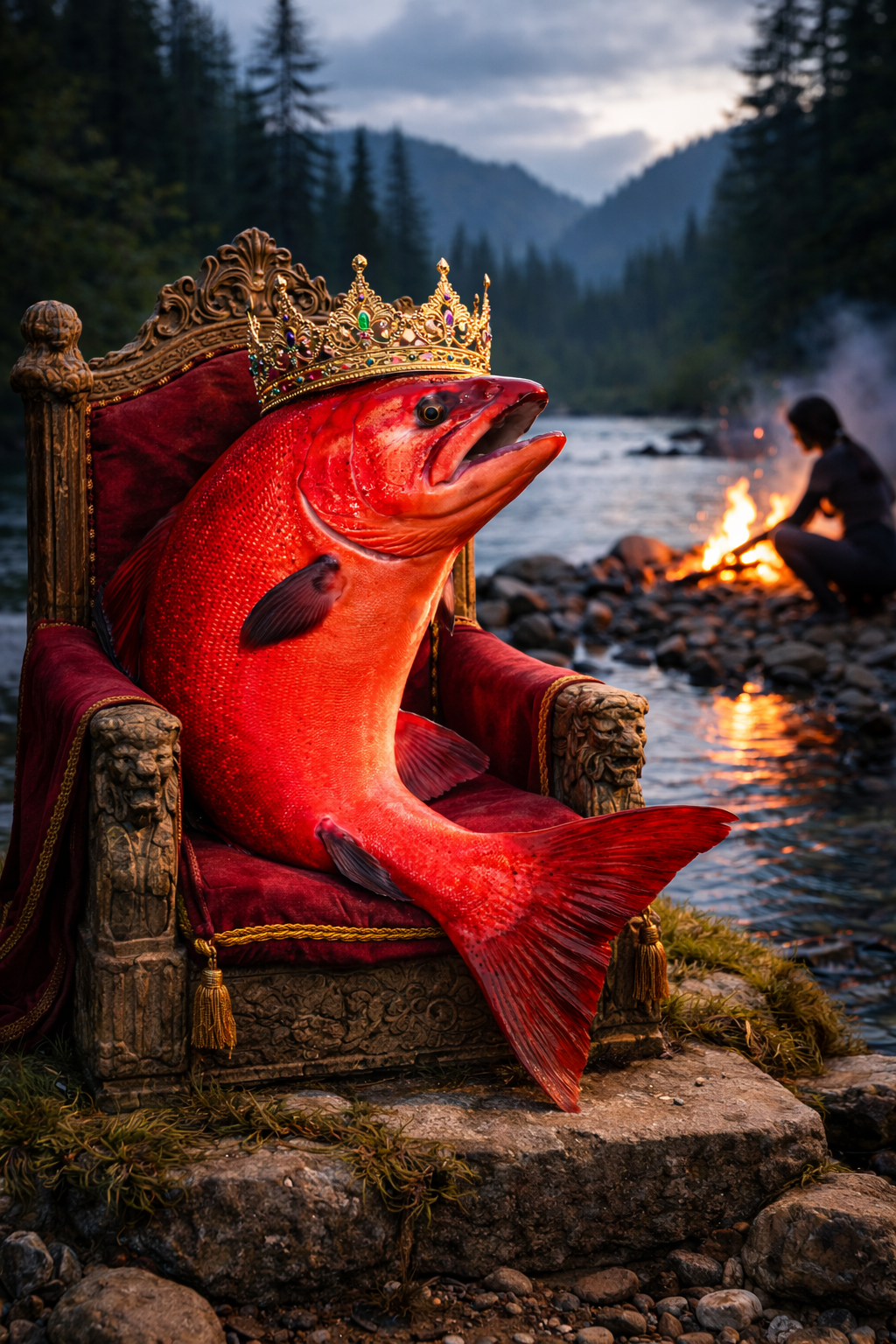
King Salmon Coronation—I’d duel a bear for you
Roses are red, but frankly who cares—
Your scales shimmer brighter than billionaire heirs.
The ocean once filed for a patent on blue,
But blushed into coral when it gazed upon you.
Poseidon once wept in briny despair,
Neptune unclutched at his sea-salted hair.
For none of their kingdoms, had water so fresh
To produce such a fillet of miracle flesh.
When tides rise high, I’ll build you a throne
From driftwood, sea glass, and beluga bone.
When tides sink low, I’ll sing you ballads
While accompanying you with sourdock salads.
Chowders will chant your wild silvery name.
Bisques will whisper, “Farmed tis not the same.”
The shrimp form choirs. The scallops applaud.
Even the haddock nods solemnly, awed.
You belong in a pasta, like Renaissance art.
With cream cheese on a bagel, a cultural start.
But kissed by smoke in an alder embrace?
Michelangelo would weep from one little taste.
I’d cross seven seas with a fork held high,
Defy maritime law, ignore FDA cries.
I’d duel a bear in a riverside brawl
Yes, I’d duel a bear in a riverside brawl…
If he so much as looked at you wrong in the fall.
Too fat? Impossible. Blasphemy. Lies.
More king to adore is simply more prize.
More ounces of glory, more sovereign might,
More majestic marbling catching the light.
Let lesser fish swim in mediocrity’s stream—
You are the sashimi of destiny’s dream.
You are the sear in my cast-iron pan,
The omega-3 of my five-year plan.
So reign, my king, in freezer or flame,
In vacuum-sealed glory or plated acclaim.
So doubt not thy worth, O monarch divine—
For I shall consume thee. Reverently. You're mine.
Eagle Parody-
Watch Eagle King on youtube or listen below—
Two versions of the same idea:
a darker, grounded male vocal, and a slower, more atmospheric female rendering beneath the lyrics.
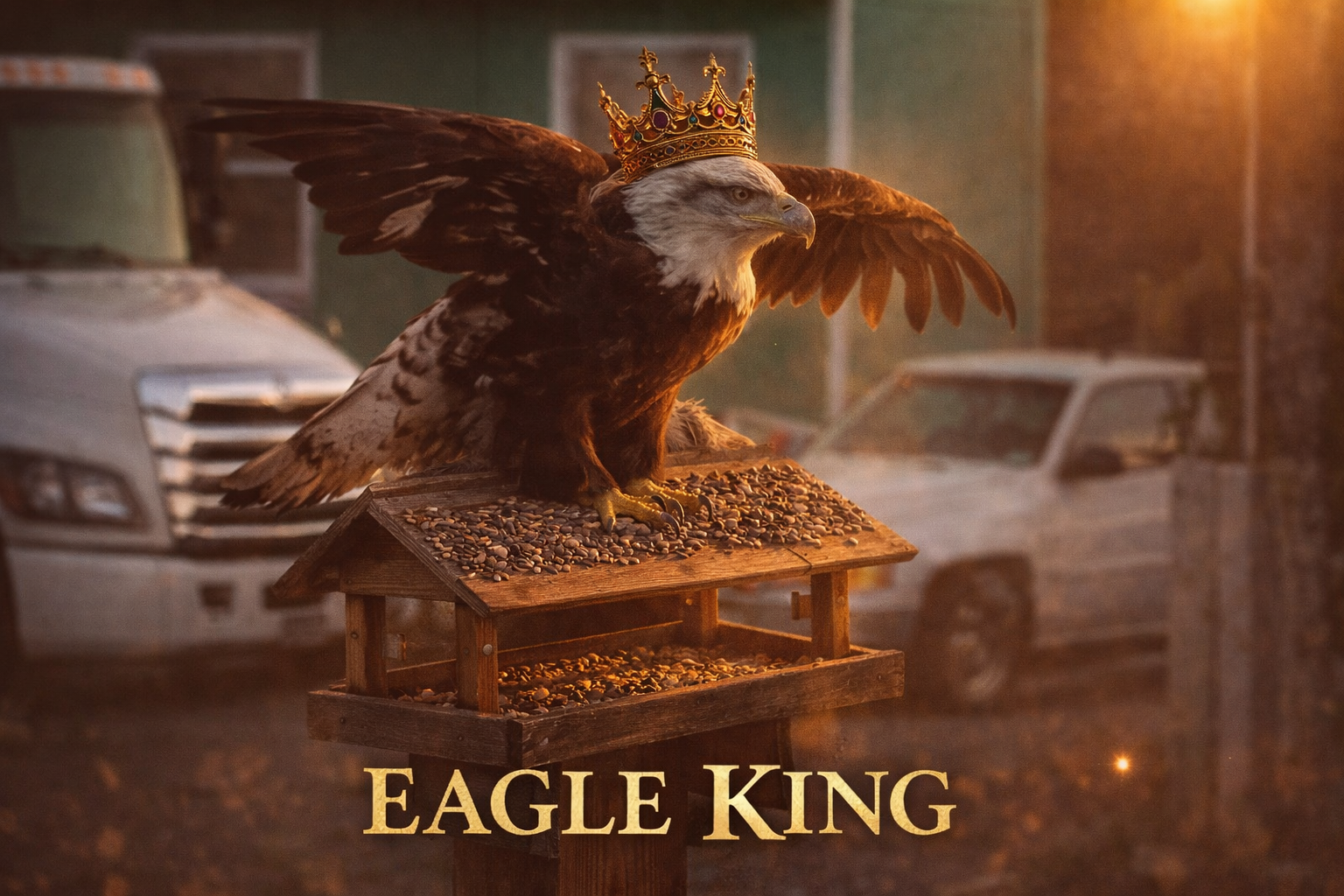
Eagle King on Bird Feeder
Lyrics: Dinnertime behind the grocery store light,
Snow drifts glow in the sodium night.
There on a throne of steel
Sat an eagle with a frozen-dinner meal.
Majestic eyes, ancient stare,
French fry grease in royal hair.
From Michelin stars to discarded meat rare
The king of the sky is already there
He’s the dumpster king of the north tonight,
Lord of the leftovers, ruler of light.
Majestic wings and an onion ring crown,
Biggest bird in this whole dang town.
Narrators speak in voices low and grand,
Funny they never mention the hot-dog stand.
From glacier cliffs to the A.C. bin,
Nature’s wild… but it loves free din.
Partner bird up on the powerline throne,
Watching pedestrians on her own
She lets out a scream like a haunted violin,
“Did you find the rotisserie chicken again?”
He lifts one wing like a slow salute,
Drops a chicken bone by a snow boot.
Tourists whisper, “Look! So wild and free!”
While he’s calculating sodium intake silently,
waiting for the pizza delivery.
He’s the dumpster king of the north tonight,
Snow in the moon and a parking-lot light.
Feathers dark like a preacher’s coat,
Fish-hawk voice with a junk-food note.
From mountain wind to a yogurt lid,
The wilderness inspects what we did and hid.
Nature documentaries never show
The midnight shift behind Costco.
Where legends glide on wings of grace
Then steal a donut with perfect face.
Yeah the dumpster king of the north tonight,
Guardian spirit of fluorescent light.
Wild as thunder, proud and tall…
But he’ll still eat nachos behind the mall.
Freedom tastes like melted cheese.
Just mind your manners, thanks and please.
Borrowed Voice
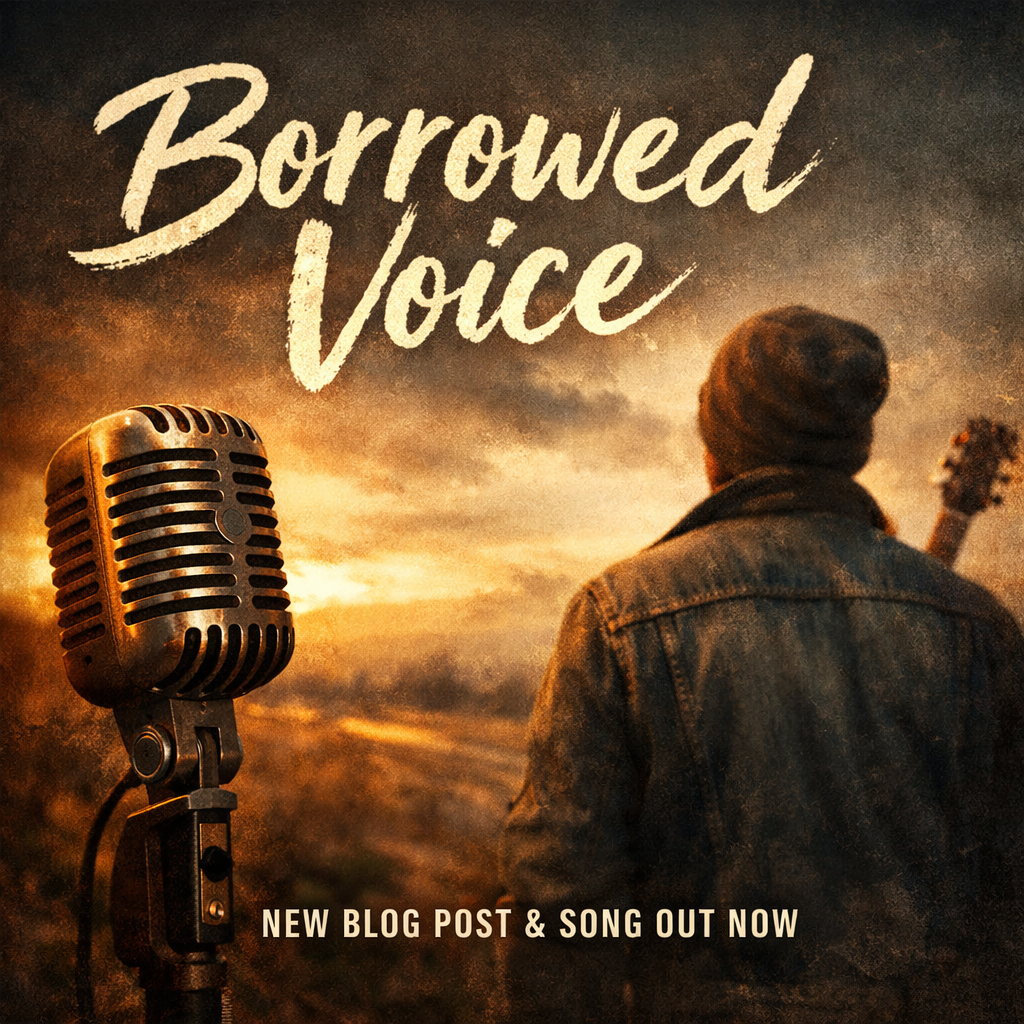
Listen here
I asked a question soft but clear
And watched it vanish 'fore it reached their ear
The same question returned—dressed a different way
And all ears hear what I was trying to say.
Something shifts—but we don't name it
Not the truth—but whose mouth gets to frame it
Say it in a borrowed voice
A different key, that gives you choice
Change the tone, unlock the door
They hear it now… they didn't before
I've seen ideas fall like rain
Then rise again with a different name
A steadier hand, a deeper tone
Now it lands on its own
We call it logic, call it sense
But it’s a wild weed seed blooming…
on the cultivated side of the fence
Same seed, different skin
Now the truth comes circling in
Change the key, unlock the door
They hear it now… they didn't before
A steadier hand, a deeper tone
Now it lands on its own
What if we traded voices for a day
Let the stories blend another way
Would her story sound the same
If it borrowed his story’s name?
Would they hear what was dismissed
If it spoke through lips they don’t resist?
Truth won't change its shape or face
But it travels… place to place
Same truth, different skin
Hope they're ready to let it in
It was never what was said out loud
Just the way it wasn't allowed
Not the truth… just the tone
Not the seed… just how it's grown
Same seed… different soil~